Sash windows are one of the best features of a period home, and one of the fussiest to dress. Deep but uneven reveals, staff beads, working shutters and a meeting rail halfway up all affect where a roller blind can go. Get the position right and roller blinds for sash windows look as if they were always there.
Quick answer: Roller blinds work well on sash windows. Fit them inside the recess where the reveal is deep and square enough, or on the architrave or wall above when shutters, shallow reveals or blackout needs rule the recess out. Check the staff beads, window board and shutter boxes first, and use reversible fixings in listed homes.
Are roller blinds suitable for sash windows?
Roller blinds are well suited to sash windows because they are slim, simple and sit neatly within or above a period window without hiding its shape. They roll away completely by day, leave the sashes free to slide, and can be made to fit uneven Victorian and Edwardian openings. The key is choosing the right fitting position.
Unlike curtains, a roller blind does not need a pole or wall space either side, which matters in narrow terraced rooms and bays. Unlike blinds with slats, it has one smooth surface that is easy to clean and does not clutter a window with lots of horizontal lines. With the right fabric, the same blind can give daytime privacy, bedroom blackout or extra insulation on draughty glass.
The trade-off is that sash windows rarely give a blind a perfectly square, uncluttered space to fit into. Understanding the parts of a sash window makes the choices much clearer.
Which parts of a sash window affect a roller blind?
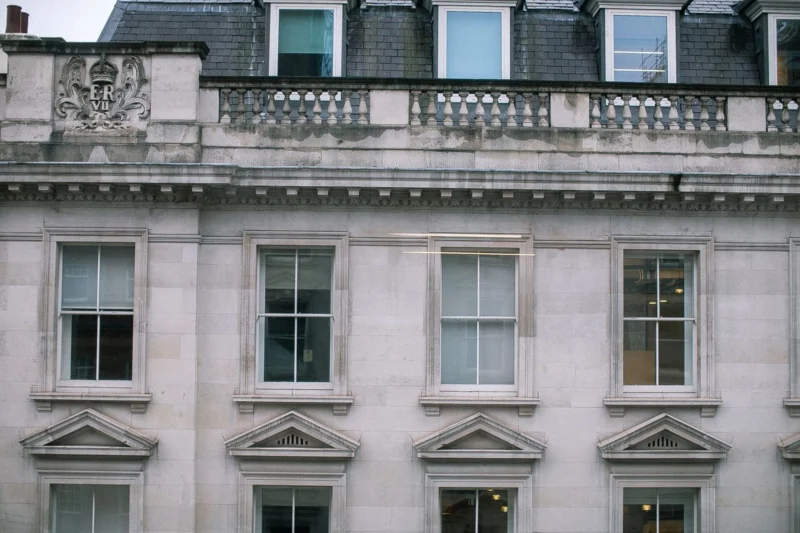
The parts of a sash window that affect a roller blind are the staff beads, the recess depth, the window board, the meeting rail, the architrave and any shutter boxes. Each one limits where brackets can go or how far the fabric can drop, so a quick look at all six tells you which fitting method will work.
- Staff beads are the thin timber strips on the room side that hold the lower sash in its track. Brackets usually sit in front of them, not on them, so the sash can still slide and the beads can be removed for repairs.
- Recess depth is the distance from the staff bead to the room face of the wall. Period walls are thick, but plaster, linings and later changes make this vary.
- The window board is the internal sill. In older houses it often projects into the room and may carry a moulded nosing that a blind must clear.
- The meeting rail is where the two sashes overlap in the middle. It carries the sash fastener, which sticks out and can catch fabric.
- The architrave is the moulded timber frame around the opening on the room side, a common place to fix a blind outside the recess.
- Shutter boxes are the panelled recesses either side of the window that hold folding internal shutters in many Georgian and Victorian houses.
Should a sash window roller blind go inside or outside the recess?
A sash window roller blind should go inside the recess when the reveal is deep enough to clear the sash fastener and the opening is reasonably square. It should go outside the recess, on the architrave or wall, when you need blackout, when shutters must still close, or when the recess is shallow or out of true.
| Fitting position | Advantages | Watch out for |
|---|---|---|
| Inside recess | Shows off the architrave and window board; tidy, built-in look | Light gaps at the sides; needs depth to clear the sash fastener; uneven reveals |
| On the architrave | Covers the whole opening; fewer light gaps; avoids fixing into plaster | Hides some moulding; fixings go into original joinery |
| On the wall above | Best blackout; blind can roll up clear of the glass entirely | Needs a solid fixing above; must clear the window board below |
Measure the recess width at the top, middle and bottom. Old openings are often wider or narrower at one end, and a recess blind must be made to the tightest point. If the difference is large, an outside fit will look better, because the eye does not pick up the uneven edge gap. Our guide to measuring and fitting explains how we handle out-of-square openings.
Can a roller blind cover only the lower sash for privacy?
A roller blind can cover only the lower sash if it is fitted in the recess at meeting rail height, so the roll sits level with the rail and the fabric drops over the bottom sash alone. The upper sash stays uncovered for daylight. A standard full-height blind lowered halfway covers the top instead, which is rarely what people want.
Lower-sash privacy is a common request in ground-floor front rooms of terraced houses, where the pavement is close to the window. The practical options with roller blinds are:
- A café-style blind at the meeting rail. Brackets sit on the reveal in front of the staff beads, level with the rail, so the sash still slides behind.
- Two blinds. A sunscreen fabric on the lower sash for daytime privacy and a full-height blackout or dim-out blind for night.
- Day and night fabric. Alternating sheer and solid bands let one full-height blind adjust privacy and light.
For privacy with light, our guide to day and night roller blinds covers how the bands work.
How do you get blackout on a sash window?
Blackout on a sash window comes from fitting outside the recess with a generous overlap, not just from the fabric. Blackout fabric stops light passing through, but a recess-fitted blind always leaves gaps at the sides of an old, uneven opening. Fixing the blind on the architrave or wall above, and overlapping each side, closes most of that light.
Bedrooms in period houses often face straight onto streetlights or morning sun, and the uneven reveals of a sash window make edge gaps worse than on modern windows. For the darkest result:
- fit the roller on the wall or architrave above the opening, clear of the top of the upper sash
- make the blind wider than the opening so it overlaps each side
- let the bottom bar rest on or just over the window board
- choose a blackout fabric rather than dim-out
Where shutters exist, closing them with a blind behind them gives excellent blackout too. See our page on blackout roller blinds for fabric options.
Do roller blinds reduce heat loss through sash windows?
Roller blinds reduce heat loss through sash windows by trapping a layer of still air between the fabric and the glass, cutting the chill from cold panes at night. Historic England notes that heat loss through windows can be significantly reduced using curtains, interior shutters and blinds. A close-fitting blind helps most on draughty, single-glazed sashes.
Historic England’s guidance on improving historic windows treats blinds, shutters and curtains as a practical, reversible way to keep more heat in without replacing original sashes. How well a blind performs depends on how closely it fits: gaps at the edges let cold air slip round the fabric and down into the room.
A blind is not a substitute for draught-proofing. Rattling sashes lose heat around the moving parts, and fixing that is a separate job for a joiner or sash specialist. But once the draughts are reduced, a roller blind closed at dusk makes a noticeable difference to how cold the window area feels. Thermal fabrics are designed to add to that effect. Our page on thermal roller blinds explains the options.
Can you fit roller blinds to sash windows with working shutters?
Roller blinds can be fitted to sash windows with working shutters, but the blind must not stop the shutters folding out and closing. That usually means fixing the roller in the recess close to the glass, inside the line of the closed shutters, or fitting it high on the wall above the shutter boxes, clear of the panels.
Original folding shutters are worth keeping usable, both for their character and for the insulation they give at night. Before any bracket goes up:
- Open the shutters fully out of their boxes and close them across the window.
- Note how far into the room the closed panels sit, and whether they have a locking bar.
- Check the space between the closed shutters and the staff beads.
- Choose a fitting position that leaves the shutters free to fold both ways.
If the space inside the shutter line is too tight, fitting above the shutter boxes is often the neatest option. The blind then drops in front of closed shutters or covers the window on its own when they are folded back.
Do you need permission to fit blinds in a listed building or conservation area?
Permission to fit blinds in a listed building depends on whether the work affects the building’s character. Historic England says Listed Building Consent is needed for alterations that affect a listed building’s special interest, and unauthorised works are a criminal offence. Simple internal blinds are often uncontroversial, but ask your local conservation officer before drilling into historic joinery.
Historic England’s guidance on Listed Building Consent recommends speaking to the local planning authority’s conservation officer first, because they can say whether consent is needed. That applies to interiors as well as exteriors. Conservation area controls usually focus on the outside of a building, so an internal blind in an unlisted house is unlikely to need consent, but check if your area has special restrictions.
Whatever the status, the good-practice approach is the same:
- fix into later or replaceable material, such as modern plaster or a batten, rather than original mouldings where possible
- keep fixings small and few, so they are easy to fill if the blind is removed
- avoid fixing into staff beads, shutters or sashes
- keep a note and photographs of where fixings were made
How do you fit roller blinds to a sash bay window?
Roller blinds for a sash bay window are fitted as separate blinds, one for each sash opening, so every window can still open and close independently. In a square bay the blinds usually sit inside each recess. In a splayed Victorian bay, the angles and narrow piers between windows decide whether recess or outside fitting works best.
Many Victorian and Edwardian terraces have a splayed bay with three sashes: a wide centre window and two narrower side windows. Fitting a blind in each recess keeps the bay’s lines clean. Outside fitting on the piers between windows needs care, because the blinds can meet at the corners and must not clash when rolled down.
Matching the bottom bar heights across the bay makes the whole window look ordered, even when the openings themselves vary slightly. Our guide to roller blinds for bay windows covers angled bays, corner gaps and measuring each opening.
Common mistakes with sash window roller blinds
The most common mistakes with sash window roller blinds come from treating a period window like a modern one. Fixing onto staff beads, ignoring the sash fastener, measuring only once across an uneven recess and blocking working shutters all cause problems. Each is easy to avoid with a careful look at the window before ordering.
- Fixing brackets to the staff beads. It can stop the sash sliding and makes future repairs harder.
- Forgetting the sash fastener. A recess blind too close to the meeting rail catches every time it comes down.
- Measuring the recess once. Old openings vary; measure top, middle and bottom.
- Blocking shutters. Once brackets are in the way, the shutters become decoration.
- Expecting blackout from a recess fit. Uneven reveals always let light round the edges.
Getting roller blinds for sash windows in London, Essex and North Kent
Roller blinds for sash windows in London, Essex and North Kent are best measured in the home, because period windows vary so much from house to house. Victorian and Edwardian terraces across London, and in many towns in Essex and North Kent, often have original or replica sashes with their own quirks.
HD Blinds offers a free home measure across London, Essex and North Kent. We measure every opening ourselves, look at beads, boards and shutters, bring fabric samples and give a written quote with no obligation. Our own team fits every blind.
Key takeaways
- Roller blinds suit sash windows because they are slim, simple and leave the sashes free to move.
- Check staff beads, recess depth, window board, meeting rail, architrave and shutter boxes before choosing a position.
- Fit inside the recess for a neat look; fit outside for blackout or when shutters and shallow reveals get in the way.
- A close-fitting blind helps keep heat in on single-glazed sashes, alongside draught-proofing.
- In listed buildings, speak to the conservation officer and use small, reversible fixings.
Frequently asked questions
Will a roller blind stop my sash window from opening?
A roller blind should not stop a sash window opening if the brackets are fixed in front of the staff beads, or on the architrave or wall. The sashes slide behind the blind. Problems only arise when brackets are screwed into the beads or sashes themselves, so check the fitting position before drilling.
How deep does a recess need to be for a sash window roller blind?
The recess needs enough depth in front of the staff beads to hold the brackets and rolled fabric, while clearing the sash fastener when the blind is lowered. The exact figure depends on the blind size and fabric thickness. If the depth is tight, fitting on the architrave or wall is usually the better answer.
Are roller blinds better than shutters for sash windows?
Roller blinds and shutters do different jobs. Original shutters are excellent at night for insulation and blackout, while roller blinds offer daytime privacy fabrics and roll away completely. Many period homes use both, with the blind fitted so the shutters can still fold out and close across the window.
Can I fit blinds in a listed building without consent?
Listed Building Consent is needed for works that affect a listed building’s special interest, and unauthorised work is a criminal offence. A simple internal blind with small fixings is often acceptable, but only the local conservation officer can confirm. Ask before fixing into original joinery, shutters or mouldings.
What is the best roller blind fabric for a draughty sash window?
A thermal or blackout fabric fitted close to the opening works best on a draughty sash window. Thicker, coated fabrics hold a layer of still air against the glass. Pair the blind with draught-proofing, because a blind reduces the chill from cold glass but does not seal gaps around the sashes.
Thinking about new blinds?
We measure and fit across London, Essex and North Kent. The visit is free and there is no obligation.