
Reference
Roller Blind Glossary
Every term you will meet on a quote, a spec sheet or a fitting instruction, in plain English. If a supplier has used a word at you and you were not sure whether to ask, it is probably here.
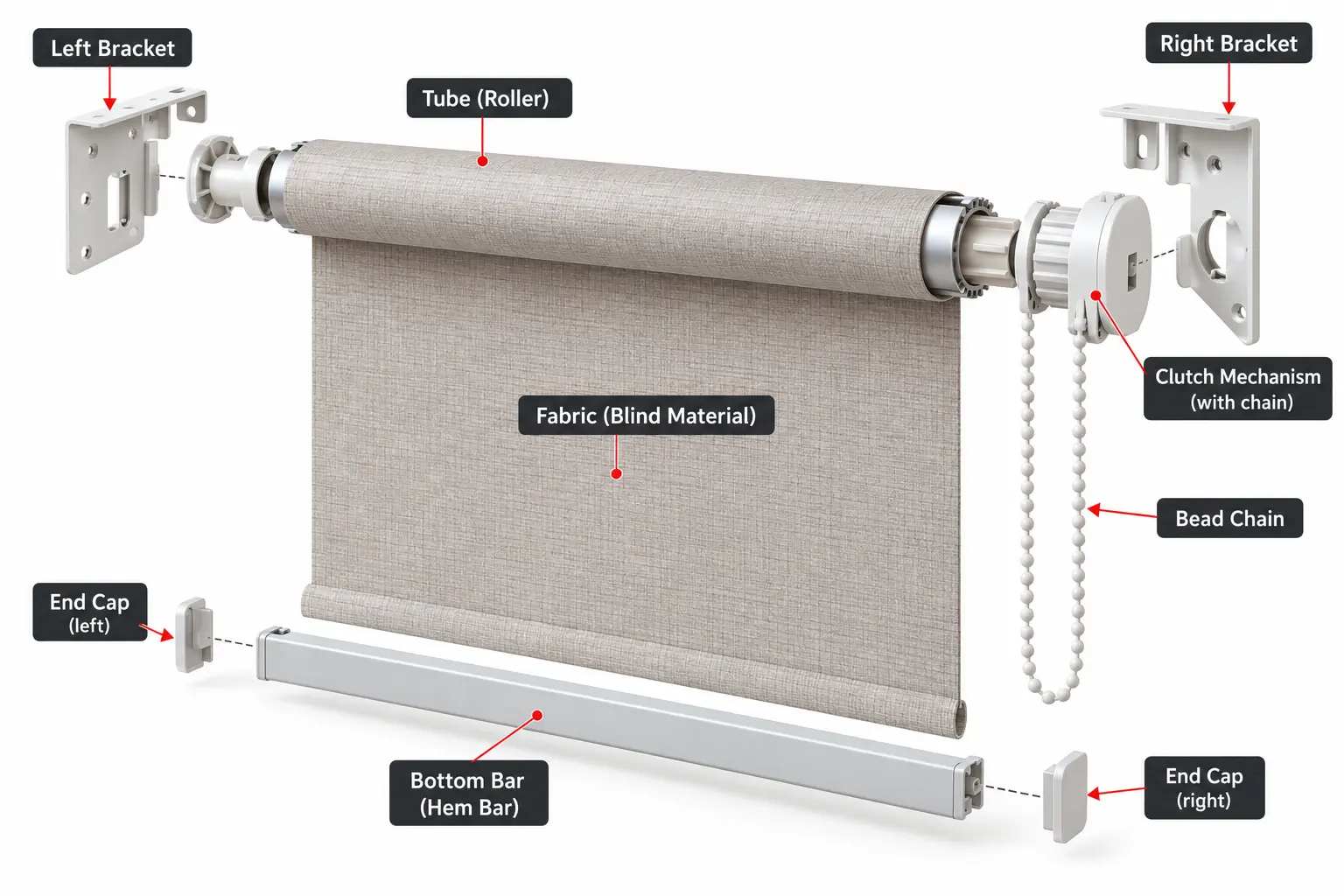
The parts of a roller blind
- Barrel / tube
- The aluminium cylinder the fabric wraps around. Diameter varies with the size of the blind: a wider or longer blind needs a fatter tube to stop it flexing in the middle.
- Bottom bar
- The weighted bar at the foot of the blind that keeps the fabric hanging straight. Sits either in a sewn pocket or in an open channel. Available in plain aluminium, wrapped in the fabric, or with a shaped profile.
- Brackets
- The two fixings the blind sits in. One takes the control mechanism, the other takes the idle pin. Side-fix brackets screw into the reveal walls; top-fix brackets screw into the ceiling of the recess or the wall above.
- Cassette
- An aluminium box that encloses the rolled-up fabric and the mechanism. Tidier, keeps dust off the roll, and on a blackout blind it closes the light gap at the top. Needs more recess depth.
- Clutch
- The mechanism in the control end that lets the chain raise and lower the blind and holds it at any height. Runs on friction, which is why you never oil one.
- End cap / idle end
- The plug at the non-control end of the tube, carrying the pin that sits in the bracket.
- Fascia
- A flat cover across the front of the roll, open at the back. Less enclosing than a cassette but needs less depth.
- Side channels
- U-shaped tracks fitted down each side of the window that the fabric edges run inside. The only way to genuinely eliminate side light gaps, and essential on skylights where gravity would otherwise pull the fabric away from the glass.
Fit, size and measurement
- Recess
- The opening the window sits in, measured from wall face to wall face. Also called the reveal.
- Recess fit
- The blind sits inside the recess. Neat and flush, with small light gaps at the sides. Also called an inside or exact-recess fit.
- Exact fit / face fit
- The blind is fixed to the wall or frame in front of the window and overlaps the opening. Blocks more light and hides an out-of-square recess. Also called an outside fit.
- Drop
- The vertical measurement: how far the blind comes down. Always quoted second: a blind described as 900 × 1,600 is 900 wide.
- Deduction
- The allowance the manufacturer takes off a recess width so the blind runs without binding, usually 6 to 10 mm in total. You supply the true recess size; they apply the deduction. Never do it yourself as well. See the measuring guide.
- Return
- The short angled or square section at each end of a bay window that runs back to the wall.
- Made to measure
- Built to your exact sizes. See made to measure vs ready made.
- Perfect fit
- A frame that clips into the rubber gasket of a double-glazed unit with no drilling at all. The blind moves with the window when it opens. Only works on suitable uPVC profiles.
Fabric terms
- Blackout
- A fabric with an opaque coating that stops light passing through the material itself. It does not stop light coming round the edges: that is down to the fit. See blackout roller blinds.
- Dimout
- Heavily reduces light without blocking it completely. Often sold alongside blackout and frequently confused with it. A dimout blind in a bedroom will still show a bright rectangle at 5am in June.
- Openness factor
- On a sunscreen fabric, the percentage of the surface that is holes. 1% is very dense and very dark; 10% is open and keeps a clear view out. 3 to 5% is the usual domestic choice.
- Screen fabric
- A woven fabric with a regular open weave that cuts glare and UV while letting you see out. Provides daytime privacy only: after dark, with the lights on, it works the other way round.
- Thermal / metallised backing
- A reflective layer laminated to the back of the fabric to reduce heat loss through the glass in winter and heat gain in summer. See thermal roller blinds.
- PVC / moisture resistant
- A wipeable coated fabric that tolerates steam and splashes. The right choice for bathrooms and above a hob. See waterproof roller blinds.
- Flame retardant (FR)
- Fabric treated or inherently constructed to resist ignition, tested to BS 5867-2:2008 Type A, B or C. Type B is the usual requirement for commercial premises. See commercial roller blinds.
- Delamination
- The coating separating from the fabric backing, usually caused by soaking, machine washing or steam. It cannot be repaired. See how to clean roller blinds.
- Fade resistance / lightfastness
- How well a fabric holds its colour under sunlight. Matters most on a south-facing window and on darker colours, which show fading first.
Operation and controls
- Chain / side winder
- The continuous loop of plastic or metal beads that drives the clutch. The most common control and the cheapest to replace.
- Control side
- Which end of the blind the chain or motor sits. Specified when the blind is made and not usually changeable afterwards, so decide before ordering.
- Spring mechanism
- A sprung tube operated by tugging the bottom bar. No chain, so no cord hazard, but less precise and the tension weakens over the years.
- Cordless
- Any blind with no operating cord or chain at all: spring, wand or motor. The safest option in a child's room. See child-safe roller blinds.
- Motorised
- A motor inside the tube, operated by remote, app, wall switch or timer. Battery, plug-in and hard-wired versions exist. See motorised roller blinds.
- Tube motor
- The motor type used in almost all domestic motorised roller blinds, housed inside the barrel so nothing is visible from the room.
- Limits
- The top and bottom stop positions programmed into a motorised blind so it always travels to the same points.
- Standard roll
- Fabric comes off the back of the tube, nearest the glass. The default, and it keeps the blind close to the window.
- Reverse roll
- Fabric comes off the front of the tube. Used to clear a handle, a deep bead or a projecting sill.
- Tracking
- When the fabric creeps sideways along the tube as the blind is raised. Almost always an unlevel bracket rather than a faulty blind. See how to fit roller blinds.
Standards and safety
- BS EN 13120:2009+A1:2014
- The British and European standard covering internal blinds, including the child safety requirements for cord and chain loops. Applies to every internal blind supplied or installed in the UK.
- Breakaway connector
- A device in a chain loop designed to come apart under load, so the loop cannot stay closed around a child's neck.
- Cleat
- A wall-mounted hook that the chain is wound around so no loop hangs free. Only works if it is actually used, every time, which is why cordless is the better answer where children are concerned.
- Tensioner
- A device screwed to the wall that holds the chain loop taut and close to the wall, removing the loop hazard without needing to be operated.
- BS 5867-2:2008
- The standard for the flammability of fabrics used in curtains and blinds. Type A is the lowest requirement, Type B covers most commercial premises, Type C is the most demanding.
Blind types you may be offered instead
- Day and night / Vision / Zebra
- Three names for the same product: alternating sheer and opaque bands on a double layer of fabric that align to let you dial the light up or down. See day and night roller blinds.
- Vertical blind
- Hanging fabric louvres that rotate and draw back. Traditional on wide patio doors. See roller vs vertical.
- Venetian blind
- Horizontal slats in aluminium, faux wood or timber that tilt. See roller vs Venetian.
- Roman blind
- A soft fabric blind that folds into horizontal pleats as it rises. Softer look, more fabric bulk at the top. See roller vs Roman.
- Pleated blind
- A concertina of stiffened fabric, often used in conservatories and on skylights because it can be tensioned between two rails.
- Panel blind
- Wide flat fabric panels that slide past each other on a track. Used on very wide openings and as room dividers.
Related guides
How to measure roller blinds
Where most of these terms get used.
How to fit roller blinds
Brackets, roll direction and levelling.
Blackout vs sunscreen
Openness factor in practice.
How much do roller blinds cost?
What each option adds to the price.
Child-safe and cordless blinds
BS EN 13120 in plain terms.
All guides
The full library.
Still not sure what you have been quoted for?
Send us the quote or call us and we will go through it with you, line by line, whether or not you end up buying from us.
HD Blinds, Rainham, Essex. Measuring and fitting across London, Essex and North Kent.