
Step-by-step guide
How to Measure for Roller Blinds
Decide first whether the blind sits inside the window recess or on the wall in front of it. Then measure in millimetres with a steel tape, take the width in three places, and never round anything up.
- Free home measuring across London, Essex and North Kent
- If we measure it and it is wrong, we remake it
- Takes about ten minutes per window to do yourself
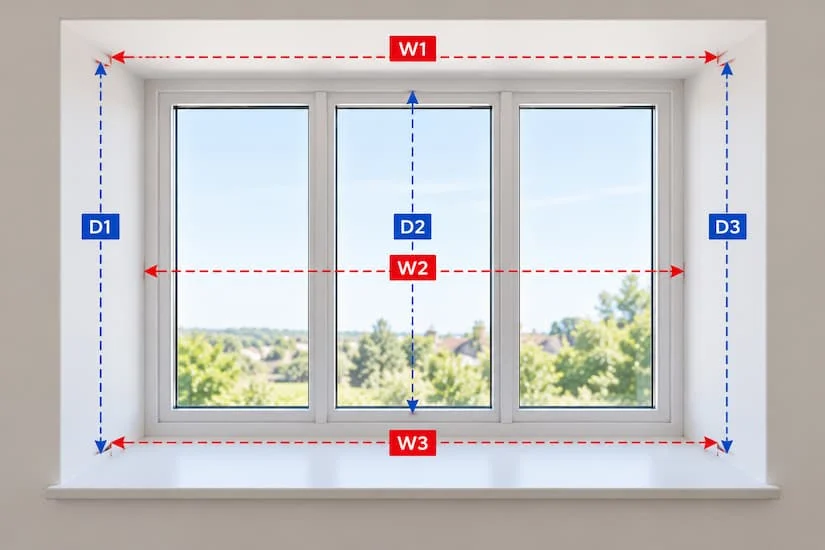
Before you start, you need four things: a steel tape measure (not fabric), a pencil, paper, and a decision about recess or exact fit. Work in millimetres throughout: 1,204 mm is unambiguous in a way that "about 120.5 cm" is not, and every UK blind manufacturer works in millimetres.
Step 1: Recess fit or exact fit?
This decision changes every measurement that follows, so make it first.
Recess fit (inside the reveal)
The blind sits inside the window opening. Neater, flush with the wall, does not block a sill you use. The trade-off is small light gaps at the sides, typically 6 to 10 mm, because the blind must be slightly narrower than the opening to run freely.
Choose this if: the recess is at least 70 mm deep, reasonably square, and you want a tidy look.
Exact fit (outside / face fit)
The blind is fixed to the wall or the frame above the window and overlaps the opening on all sides. Blocks far more light, hides an ugly or out-of-square recess, and makes a small window look larger.
Choose this if: the recess is shallow, badly out of square, or you need genuine blackout. See blackout roller blinds.
If you want the darkest possible bedroom, exact fit with a generous overlap beats recess fit every time. We explain why on the bedroom blinds guide.
Step 2: Measuring for a recess fit
- Measure the width in three places. Across the top of the recess, across the middle, and across the bottom. Write all three down.
- Use the smallest of the three. Not the average. If the blind is built to the average it will jam at the narrowest point. Almost no British window recess is parallel: a 10 mm difference top to bottom is completely normal in older housing.
- Measure the drop in three places. Down the left edge, the centre and the right edge, from the top of the recess to the sill. Use the longest of the three so the blind covers the whole opening.
- Check the recess depth. Measure from the face of the wall back to the glass or the frame. You need roughly 70 mm for a standard roller to sit fully inside without the fabric touching the glass or a handle. Less than that and the blind will protrude, which usually looks worse than a face fit.
- Note any obstructions. Tilt-and-turn handles, trickle vents, opening restrictors, alarm sensors, a deep bead around the glass. Write down where they are and how far they project.
- Do not make any deduction yourself. Give the manufacturer the exact recess size and state that it is a recess fit. They apply the running clearance. If you deduct and they also deduct, the blind arrives 20 mm too narrow.
That last point is where most self-measured orders go wrong. Supply the true opening size and label it clearly as recess fit. Never do the maths twice.
Step 3: Measuring for an exact / face fit
- Decide the overlap. Standard practice is to add 60 to 100 mm to each side of the glass opening and the same above it. More overlap means less light leak.
- Measure the width you want the blind to be. With face fitting you are stating the finished blind size, not the window size. Measure the opening, add your overlap to each side, and that total is the width you order.
- Measure the drop you want. From where the brackets will go, down to where you want the blind to end, usually 50 to 100 mm below the sill, or to the floor for a patio door.
- Check what is above the window. You need about 100 mm of flat, solid wall or frame to mount the brackets. A coving, a boxed-in lintel or a curtain pole in the way changes where the blind can go.
- Check what the blind will clear. A radiator, a sill that projects, a window that opens inward. The blind must hang without fouling any of them.
With exact fit, what you give the manufacturer is the finished blind size. With recess fit, what you give them is the window opening. Getting those two the wrong way round is the second most common error we see.
The seven mistakes we see most
Measuring an existing blind
The old blind was already narrower than the recess. Copy it and the new one shrinks again. Always measure the window, never the blind.
Measuring in one place
One width and one drop assumes a square opening. Three of each takes thirty extra seconds and catches the problem.
Rounding up
1,204 mm rounded to 1,210 mm is a blind that does not go in. If you must round, round down, and only ever by a millimetre.
Using a fabric tape
Dressmaker's tapes stretch and sag over a metre. Use a steel tape held taut.
Deducting twice
You take off 10 mm for clearance, the factory takes off another 10 mm. Give the true opening and say it is a recess fit.
Forgetting the handle
A tilt-and-turn handle projects 40 to 60 mm. If the recess is shallow, the blind will sit on it.
Width and drop swapped
Width always comes first in the UK trade. A blind ordered 600 × 1,800 is 600 wide. Label both, every time.
Assuming a bay is symmetrical
It is not. Every pane in a bay window is measured separately.
Awkward windows
Bay windows
Measure each pane as a separate blind. Check the angle at each corner and the width of each return, on a 1930s splayed bay the two returns are rarely identical, and on a square bay the centre pane is often wider than the drawing suggests. Full detail on the bay window guide.
French and patio doors
Measure each door leaf individually if you are fitting to the leaf, and check the handle projection: the blind must clear it when the door swings. For sliding doors, decide whether you want one wide blind across the whole run or separate blinds per panel. See French and patio door blinds.
Skylights and Velux
Velux windows carry a type and size code on a plate inside the frame, usually at the top. Give us that code and the measurement is done. For non-Velux skylights, measure the glass opening and the depth available for side channels. See skylight blinds.
Conservatories
Roof panels are trapezoidal and rarely identical. This is one job we would strongly advise not measuring yourself. See conservatory blinds.
What to write down for each window
Use this as a template. One line per window, and name the room so nobody has to guess later.
| Field | Example | Note |
|---|---|---|
| Room / window | Front bedroom, left window | Be specific if there are two |
| Fit type | Recess | Recess or exact fit |
| Width: top / mid / bottom | 1,204 / 1,198 / 1,201 mm | Order to the smallest |
| Drop: left / centre / right | 1,510 / 1,512 / 1,509 mm | Order to the longest |
| Recess depth | 95 mm | 70 mm minimum for a standard roller |
| Obstructions | Tilt handle, left, projects 55 mm | Include position and projection |
| Control side | Right | Which side you want the chain or motor |
| Fabric | Blackout, warm grey | Order samples before committing |
Take a photo of each window as well. It settles most questions faster than a measurement does.
Or let us do it
We measure free of charge across London, Essex and North Kent, and there is a practical reason to take that up beyond the convenience. If you supply your own measurements and one is wrong, the blind is made correctly to the wrong number and the cost of remaking it falls to you. If we measure it, the accuracy is ours to get right, and if it is wrong, we remake it.
A measuring visit for a typical three-bedroom house takes under an hour, and you get to see fabric samples against your own walls in your own light at the same time.
Related guides
How to fit roller blinds
Brackets, levelling and the order of operations.
Made to measure vs ready made
When trimming a stock blind is the right call.
How much do roller blinds cost?
Prices by fabric and size.
Bay window blinds
Measuring each pane and return.
Skylight and Velux blinds
Using the frame code instead of a tape.
Blackout vs sunscreen
Pick the fabric before the size.


