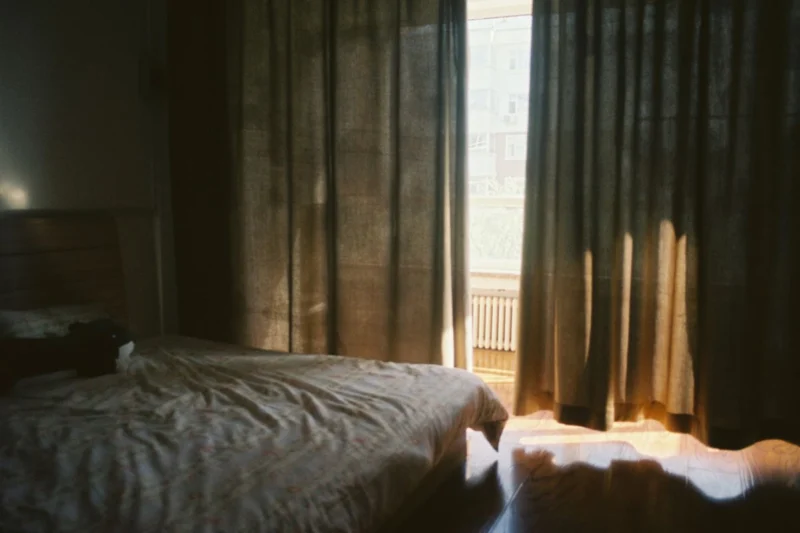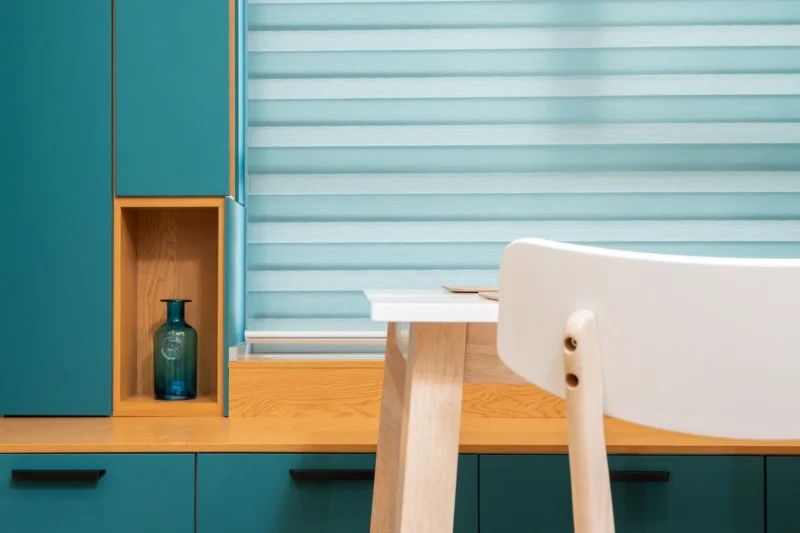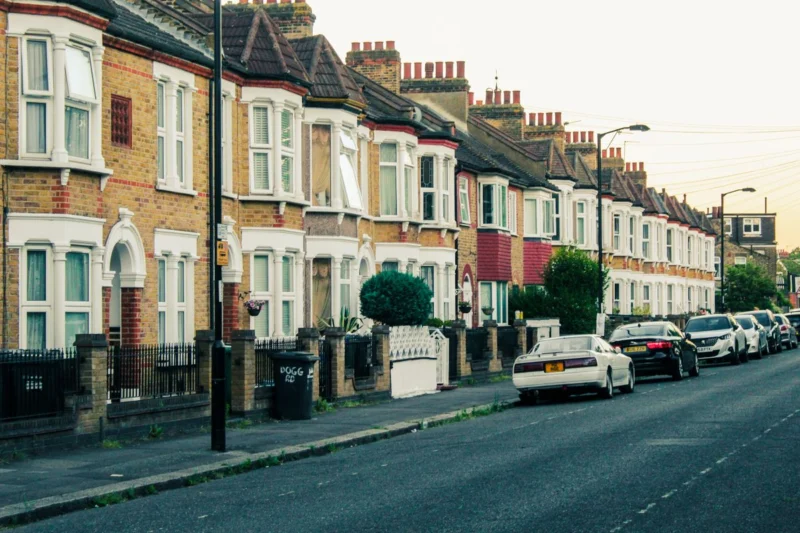
Dim-out and blackout blinds look almost identical on a sample card. Hold them up to a window and the difference is obvious, and it matters more in some rooms than others. This guide explains how each fabric is made, what you will actually see when the blind is down, and which rooms suit which.
Quick answer: Blackout fabric has a coating or bonded layer that stops light passing through the cloth itself. Dim-out fabric is densely woven or lightly treated, so it cuts most daylight but still lets a soft glow through. Choose blackout for bedrooms where darkness matters, and dim-out for living rooms, landings and rooms where you want privacy without a cave.
What is the difference between dim-out and blackout blinds?
The difference between dim-out and blackout blinds is what happens to light hitting the fabric. Blackout fabric is sealed so light cannot pass through the cloth. Dim-out fabric slows light down rather than stopping it, so the room is noticeably darker but never fully dark. Both give privacy at night, and both roll the same way.
It helps to separate two things people often mix up. One is light passing through the fabric. The other is light getting round the fabric, at the sides, top and bottom. A blackout fabric solves the first problem completely. Neither fabric solves the second on its own, because a roller blind needs a small clearance to roll freely. That edge light is covered in its own section below.
So when a sales page promises a pitch-black room from any blackout roller blind, treat it with caution. The fabric can be totally opaque and the room can still have a visible line of light round the edges on a bright morning.
How is blackout fabric made?
Blackout fabric is usually made by coating a woven base cloth with one or more layers of opaque material, often an acrylic foam, or by bonding a light-blocking layer to the back. The coating fills every gap in the weave. The result is a fabric that no daylight passes through, whatever its face colour.
A few points follow from how it is made:
- It is often slightly stiffer and heavier than a dim-out fabric of the same size. That weight can help a large blind hang flat.
- The back is usually a neutral colour, often white or off-white, so every window looks consistent from the street, whatever colour faces into the room.
- Quality shows in pinholes. A poorly coated fabric can have tiny points of light when held up to the sun. A good blackout fabric shows none.
- Some blackouts are woven with an opaque middle layer instead of a coating. They look more textile-like on the face but work in the same way.
For a full look at the blackout range and where it earns its place, see our page on blackout roller blinds.
How is dim-out fabric made?
Dim-out fabric is made with a tight, dense weave, heavier yarns or a light backing treatment that reduces light without sealing the cloth completely. Some dim-outs rely on colour and density alone. Others have a thin coating that softens light further. Either way, a little daylight still passes through the fabric and diffuses across it.
You will also see dim-out described as light filtering or room darkening. The terms are used loosely across the trade, so do not rely on the label alone. Look at the fabric against real daylight. At a home measure, we hold samples against your own window for exactly this reason: the same fabric reads very differently on a north-facing landing than it does on a sunny bedroom.
Two things change how dark a dim-out feels:
- Colour. A charcoal or navy dim-out lets far less light through than a cream one. A pale dim-out can feel only slightly darker than a thick sheer.
- Weave and weight. A heavy, tight weave blocks more than a loose, textured one, even in the same colour.
How much light do dim-out and blackout blinds let through?
Dim-out and blackout blinds differ in light through the fabric, not just in darkness overall. Blackout fabric lets no light through the cloth. Dim-out lets a small, diffused amount through, so the whole blind glows faintly in daylight. How dark the room feels then depends on fabric colour, window size and how much light escapes round the edges.
In plain terms, this is what you can expect on a bright day with the blind down:
| What you notice | Blackout | Dim-out |
|---|---|---|
| Light through the fabric | None | A soft, even glow across the blind |
| Can you read in the room? | Only with edge light or a lamp | Usually yes, in dim light |
| Can you see shapes outside? | No | No, only brightness |
| Privacy at night with lights on | Full, no silhouettes | Good, but strong backlighting can show faint shapes with pale colours |
| Look from outside | Neutral backing, flat | Fabric colour and weave visible |
| Best for | Bedrooms, nurseries, media rooms, shift workers | Living rooms, landings, dining rooms, children who dislike total dark |
We deliberately avoid quoting percentages here. Light transmission figures vary by fabric and are measured in lab conditions, and a number on a card does not tell you how a room will feel. Seeing the sample against your window tells you far more.
Why do blackout blinds still let light in at the edges?
Blackout blinds still let light in at the edges because a roller blind needs a small gap at each side to roll up without catching, and the fabric cannot seal against the frame. The fabric blocks light, but daylight still reaches the room round the sides and under the bottom bar. This glow is normal, not a fault.
How much edge light you see depends on the fit:
- Inside the recess. The blind sits close to the reveal, so gaps are small, but some light will still show down each side.
- Outside the recess. Fitted on the wall with an overlap each side, the fabric covers the reveal and blocks more edge light, especially if the overlap is generous and the blind drops below the sill.
- Top of the blind. Light can spill over the roller. A cassette or pelmet over the top reduces this. It is a general option, so ask at your measure whether it suits your window.
- Side channels. Channels that hold the fabric edges cut the side gaps further. Again, ask at your measure whether they suit your window.
The key point for this comparison: edge light affects both fabrics equally. If you choose dim-out, the edge glow blends in with the glow through the fabric. With blackout, the dark fabric makes the edges stand out more. Some people find a bright outline round an otherwise black blind more noticeable than an evenly dim room.
Which rooms suit blackout blinds?
Blackout blinds suit rooms where darkness is the whole point: main bedrooms, children’s bedrooms and nurseries, spare rooms used for daytime sleep, home cinemas and rooms with screens facing a window. They are also the sensible choice on east-facing bedroom windows, where summer sunrise can come very early.
In the UK, summer nights are short and light mornings start early, which is why bedrooms are where blackout earns its keep. The NHS advice on sleeping well suggests finding a room that is quiet, dark and cool, and a blackout fabric is the most direct way to handle the dark part.
If you are weighing blackout against a solar fabric for a sunny room, that is a different comparison, set out in our guide to blackout vs sunscreen roller blinds. For bedroom choices more broadly, see our best roller blinds for bedrooms guide.
When is dim-out the better choice than blackout?
Dim-out is the better choice when you want privacy and softer light rather than total darkness. That covers most living rooms, dining rooms, landings, hallways and home offices, plus bedrooms for people who find a fully dark room unsettling. Dim-out also keeps a room feeling lived in during the day, even with the blind down.
Living rooms
A living room blind is often down in the evening for privacy and during the day to take the edge off glare on a television. Blackout makes the room feel shut up in the daytime. Dim-out keeps a warm, even light, and from the street it shows the fabric colour rather than a plain backing.
Landings and stairs
Landing windows are often left down all day for privacy, especially in terraces where the window faces a neighbour. A blackout here leaves the stairs gloomy. A pale dim-out keeps them usable without switching lights on.
Children who dislike total dark
Plenty of children find a pitch-black room frightening. A dim-out gives a gentle low light that means they can see their room when they wake, while still taking the brightness off a summer evening. Mid or dark shades of dim-out get surprisingly close to blackout for bedtime.
Home offices
If the aim is to cut glare on a screen rather than darken the room, dim-out usually works better than blackout, because you still want daylight to work by.
Does the colour of a blind affect how dark it is?
The colour of a blind affects how dark a dim-out fabric is, but not a blackout. With dim-out, darker colours let noticeably less light through and pale colours glow more. With blackout, the coating does the work, so a white blackout blocks as much light through the fabric as a black one. Colour then only changes the look.
Colour does affect other things with blackout fabric:
- Room feel. A pale blackout reflects more lamp light back into the room at night.
- Heat on sunny glass. Pale or reflective backings bounce more sunlight back out than dark ones.
- Street view. Many blackouts have a pale backing whatever the face colour, which keeps the outside of the house consistent. Dim-out fabrics usually show the same colour on both sides.
If a consistent street view matters, for example on a Victorian terrace where every front window is visible from the pavement, check the back of every sample, not just the front.
Can you combine dim-out and blackout at one window?
You can combine dim-out and blackout at one window by fitting two blinds on separate brackets, one behind the other, or by pairing a blackout blind with a lighter blind in front. This gives full darkness at night and a softer daytime option. It needs enough depth in the recess or on the wall for two rollers.
A double blind is a common answer for rooms that change role, such as a spare room that doubles as an office, or a child’s bedroom where daytime naps and evening play happen in the same space. Another route is a day and night blind, which uses alternating sheer and solid bands. Our day and night roller blinds page explains how that fabric works. When we measure, we check recess depth and window handles first, because a second roller needs space.
How to choose between dim-out and blackout
To choose between dim-out and blackout, decide whether anyone needs to sleep in the room in daylight, whether a screen faces the window, and how much you want the room to feel open with the blind down. If darkness is essential, choose blackout. If privacy and softer light are the goal, choose dim-out in a shade to suit.
- List what happens in the room at dawn, midday and evening.
- Note which way the window faces and whether it gets direct morning or evening sun.
- Decide if darkness is essential or just nice to have.
- Look at samples against the actual window in daylight, front and back.
- Consider the fit: inside or outside the recess, and how much edge light you can live with.
- For dim-out, try a paler and a darker shade side by side before deciding.
You can order free fabric samples by post and do this at home before anyone visits.
Common mistakes when choosing dim-out or blackout
Common mistakes when choosing dim-out or blackout include buying blackout for a living room and finding it gloomy, choosing a pale dim-out for a bedroom that gets early sun, expecting blackout fabric alone to stop edge light, and judging samples under shop lighting instead of daylight at the real window.
- Choosing by the name on the sample rather than holding it up to the light.
- Forgetting that a landing or hallway blind is often down all day.
- Picking a white-backed blackout for one room and a coloured dim-out beside it, then disliking the mismatch from the street.
Getting help choosing fabrics locally
Getting help choosing fabrics locally is simplest with a free home measure. We cover London, Essex and North Kent, measure every window ourselves, and bring dim-out and blackout samples so you can compare them against your own glass in daylight. You get a written quote with no obligation, and our own team fits the blinds.
That visit is a good time to test a pale and a darker dim-out side by side in a bedroom, or to see how much edge light a recess fit will leave. You can check your postcode on our areas we cover page.
Key takeaways
- Blackout fabric is coated or layered so no light passes through the cloth. Dim-out reduces light but lets a soft glow through.
- Edge light round the sides of a roller blind affects both fabrics, and is more noticeable with blackout.
- Colour changes how dark a dim-out is, but not a blackout.
- Blackout suits bedrooms, nurseries and screen rooms. Dim-out suits living rooms, landings, offices and children who dislike total dark.
- Judge samples against your own window in daylight, front and back.
Frequently asked questions
Is dim-out the same as blackout?
No. Blackout fabric is coated or layered so no light passes through the cloth. Dim-out fabric is densely woven or lightly treated, so it reduces daylight but still lets a soft glow through. Both give privacy at night. Blackout is for rooms that need darkness, dim-out for rooms that need softer light.
Is dim-out dark enough for a bedroom?
Dim-out can be dark enough for a bedroom if you choose a mid or dark shade and the window does not get strong early sun. Light sleepers, shift workers and rooms facing east usually do better with blackout. A dark dim-out suits people who prefer a little light when they wake.
Why can I see light round my blackout blind?
A roller blind needs a small gap at each side to roll freely, so daylight gets round the edges and over the roller even when the fabric blocks it completely. An outside-recess fit with an overlap, a cassette at the top or side channels can reduce this. Ask at your measure what suits your window.
Do white blackout blinds let in more light?
No. With blackout fabric, the coating or inner layer stops light, so a white blackout blocks as much light through the cloth as a black one. The colour changes how the room looks and how much lamp light reflects back. With dim-out fabrics, though, paler colours do let more light through.
Can I have dim-out and blackout on the same window?
Yes, with a double blind: two rollers on separate brackets, usually blackout behind and a lighter fabric in front. It needs enough depth in the recess or wall space above the window. A day and night blind is another option for switching between softer light and privacy in one fabric.
Thinking about new blinds?
We measure and fit across London, Essex and North Kent. The visit is free and there is no obligation.