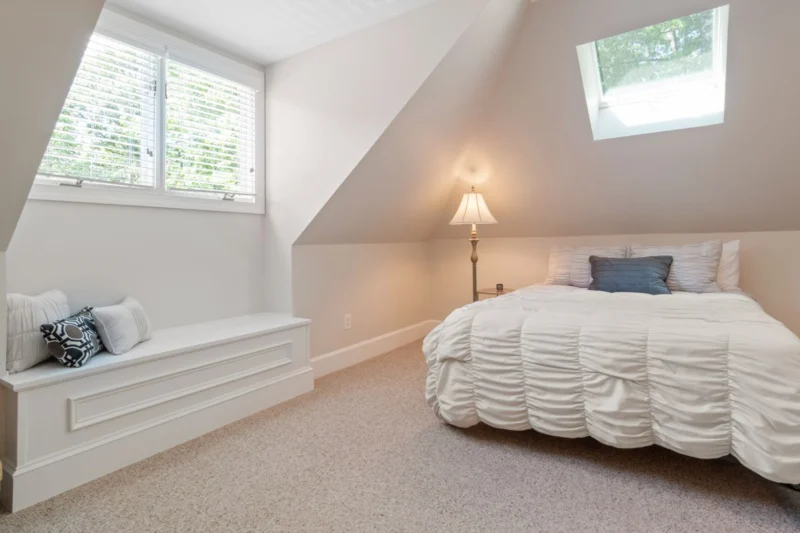
In most British homes, the radiator sits right under the window. It is the obvious place for it, and it is also the place that makes choosing a blind awkward. Get the drop or the fit wrong and blinds over radiators end up heating the glass instead of the room.
Quick answer: A blind over a radiator traps warm air between the fabric and the cold glass, so less heat reaches the room. Where a radiator sits under the window, fit the blind inside the recess and set the drop so it stops at the sill. Keep the fabric clear of the radiator and the valve reachable.
Should a blind hang over a radiator?
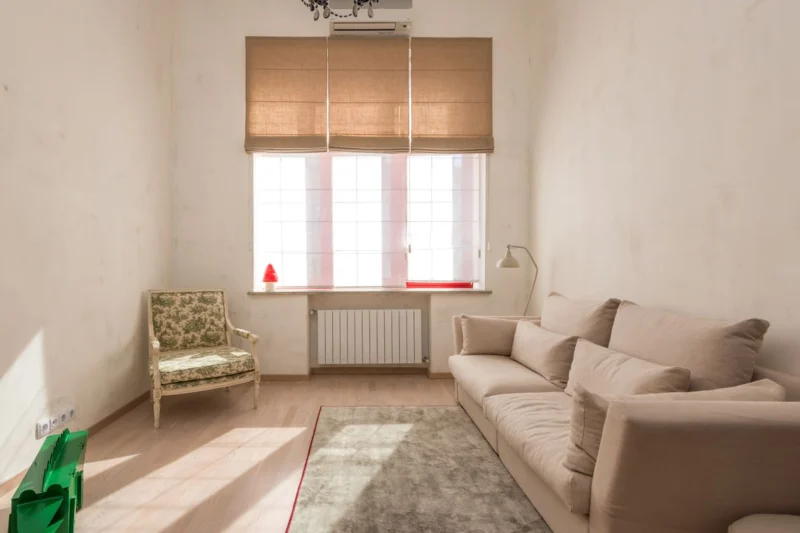
A blind over a radiator is usually a bad idea. When the blind drops in front of the radiator, the rising warm air is caught behind the fabric and pushed against the window glass, where much of its heat is lost. A blind that stops at the sill lets that heat rise into the room instead.
The same applies to curtains, which is why you often see advice to tuck curtains behind a radiator or shorten them to sill length. A roller blind has one big advantage here: it can be made to an exact drop, so it can stop precisely where it needs to without any fabric hanging loose.
There are exceptions. If the radiator is well below a deep sill, or set to one side of the window, a longer blind may not cover it at all. The rule is simple: the fabric should not sit in front of the radiator’s top or front face when it is down.
Why are radiators fitted under windows?
Radiators are fitted under windows mainly to counter the cold air that sinks down the glass. Warm air rising from the radiator meets the cold downdraught and stops it spilling across the floor. It is also practical: the wall under a window is rarely used for furniture, so the radiator takes up space that would otherwise go to waste.
This arrangement is standard in much of the UK housing stock, from Victorian and Edwardian terraces to 1930s semis and post war estates across London, Essex and North Kent. Many new build flats put radiators under windows too, although some use underfloor heating or position radiators on other walls.
The catch is that the radiator is usually on an outside wall. The Energy Saving Trust’s guide to radiator reflector panels explains that radiators on outside walls lose some heat through the wall behind them, and that reflector panels can bounce that heat back into the room. Put a blind in front as well, and you add a second route for heat to go the wrong way.
What happens when a blind hangs over a radiator?
When a blind hangs over a radiator, it creates a channel. Warm air rises off the radiator, is trapped between the fabric and the window, and heats the glass. Heat passes through the glass to the outside, so the room warms more slowly and the heating runs longer to reach the same temperature.
Three things happen at once:
- Heat goes to the glass. The warmest air in the room is directed straight at its coldest surface.
- The room side stays cooler. Less warm air reaches the space where you are sitting.
- The blind’s own benefit is lost. A closed blind normally helps by holding a layer of still air against the glass. A radiator underneath keeps that air moving, which undoes much of the effect. Our article on whether blinds keep heat in explains that insulating layer and what the test data shows.
What is the best blind drop when a radiator is under the window?
The best blind drop when a radiator is under the window is sill length: the bottom bar stops at or just above the window sill. That covers the glass fully for privacy and light control, while leaving the radiator’s warm air free to rise into the room past the front of the sill.
How well this works depends on the sill. A sill that projects out over the radiator acts like a shelf. It deflects some rising air forward into the room and keeps it away from the blind. A shallow or flush sill does less, so the gap between the bottom bar and the radiator matters more.
Points we check when setting the drop at a measure:
- Where the sill is, and whether it projects beyond the front of the radiator.
- Whether the blind will sit inside the recess, so it naturally stops on the sill.
- Whether anything on the sill, such as plants or ornaments, will stop the blind lowering fully.
- Whether the window handle will catch the blind as it drops.
- How far the bottom bar sits from the top of the radiator when fully down.
Is a recess fit better when there is a radiator under the window?
A recess fit is usually better when there is a radiator under the window. A blind fitted inside the window recess drops onto the sill and cannot hang in front of the radiator. It also keeps side gaps small, which helps the blind hold still air against the glass at night and keeps warm radiator air on the room side.
Not every window allows a recess fit. Some recesses are too shallow to take the blind’s brackets and roll, especially where window handles or tilt and turn mechanisms stick out. Others are out of square, which is common in older terraces. In those cases, a blind fitted outside the recess can still work if its drop is set to end at the sill rather than below it.
Outside recess blinds are often made longer than the window to overlap the wall below for a neat look and better light blocking. That is exactly what you do not want above a radiator. If an outside fit is the only option, the bottom of the blind should still finish at sill level, and the width can overlap the sides of the recess instead.
How much clearance should a blind have from a radiator?
Clearance from a radiator should be enough that the blind never touches the radiator, even when it swings or is disturbed. There is no single fixed distance that suits every window, because it depends on the sill, the radiator height and the fabric. As a principle, the fabric should hang freely and not rest on any hot surface.
Fabric touching a hot radiator for long periods can discolour, stiffen or distort, and the bottom bar can end up pressing against the top of the radiator every time the blind is lowered.
Practical ways to keep clearance:
- Set the drop to the sill rather than past it.
- Keep the blind inside the recess where possible.
- Avoid oversized outside recess blinds that reach down to radiator level.
- If the radiator is very close to the sill, ask at your measure whether a slightly shorter drop suits your window.
Electric heaters, including portable fan heaters and panel heaters, are a different matter. Always follow the heater manufacturer’s instructions about keeping it uncovered and clear of fabrics.
This is general information. Follow the safety instructions supplied with your radiator or heater.
Can a blind affect a thermostatic radiator valve?
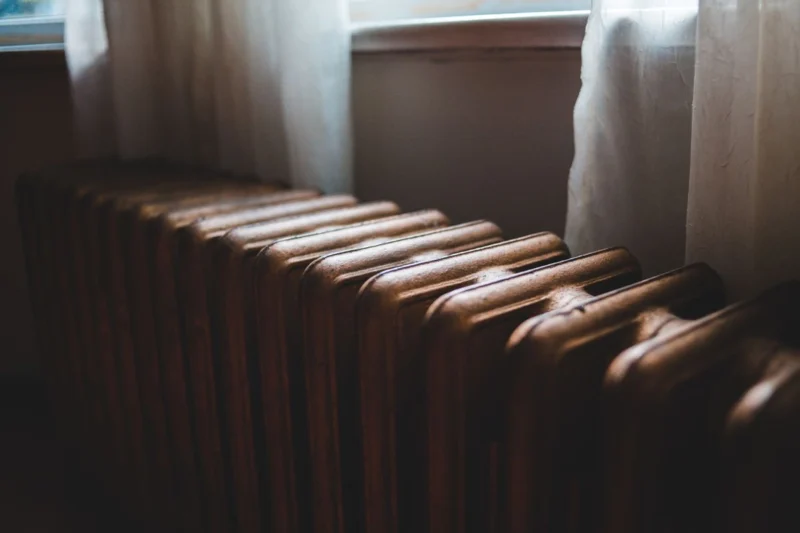
A blind can affect a thermostatic radiator valve if it traps warm air around the valve. According to the Energy Saving Trust, TRVs work by sensing the air temperature around them and close a little when the room is warmer than the setting. If that air is warmer than the room, the valve may shut down early.
The Energy Saving Trust’s heating guidance explains how TRVs respond to the air around them, and it advises keeping room thermostats clear of curtains and furniture. The same logic suggests keeping the pocket of air around a TRV open to the room. A blind that stops at the sill does this naturally.
The other issue is access. A TRV at the end of a radiator under a window needs to be reached and turned. A long blind, or a chain hanging down at the side, can get in the way. When we plan a blind, we look at which side the valve is on and which side the control should go, so you are not reaching past a chain to adjust the heating.
How do you look after blind fabric near a radiator?
Looking after blind fabric near a radiator mainly means dealing with dust and moisture. Rising warm air carries dust, which can leave faint marks on the lower part of the fabric over time. Cold glass behind a closed blind can also attract condensation, which is worth wiping away before it affects the fabric.
- Dust regularly. A soft brush or vacuum brush attachment on a low setting removes most dust before it builds up. Our guide on how to clean roller blinds covers the safe methods for different fabrics.
- Open blinds in the morning. This lets the glass dry and stops moisture sitting against the fabric. If you have ongoing damp, our article on mould and condensation on blinds explains the causes.
- Keep the fabric clear of the radiator. Fabric resting on a hot surface can discolour or distort.
- Choose sensible fabrics. In rooms with lots of steam as well as a radiator, such as kitchens and bathrooms, a moisture-resistant fabric copes better.
Are blinds or curtains better with a radiator under the window?
Blinds are usually better than curtains with a radiator under the window, because a roller blind can be made to stop exactly at the sill and sits close to the glass. Floor length curtains tend to cover the radiator entirely. Sill length curtains can work, but they need care to hang clear of the heat.
| Factor | Roller blind | Floor length curtains | Sill length curtains |
|---|---|---|---|
| Covers the radiator when closed | No, if made to sill length | Yes | Sometimes, if they hang forward |
| Warm air reaches the room | Yes | Much of it is trapped | Mostly |
| Sits close to the glass | Yes, especially in the recess | No | No |
| Access to the valve | Clear | Behind fabric | Usually clear |
| Contact with a hot surface | Avoidable | Likely | Possible |
Some people like the look of floor length curtains and use them with a blind. In that case, draw the blind at night for privacy and warmth, and keep the curtains open or tied back so they do not cover the radiator. For a broader comparison, see roller blinds vs curtains.
What about bay windows with radiators?
Bay windows with radiators need a little more planning. Radiators are often placed under the centre window of a bay or split across the side sections. Individual blinds fitted to each window of the bay, each set to sill length, keep the fabric clear of the heat while covering every pane.
A single curtain drawn across the front of a bay does the opposite. It shuts the radiator and the whole bay off from the room, so the heat warms the bay and the glass rather than the space you are using. This is a common setup in 1930s semis and Victorian terraces with big front bays.
With individual blinds, check that each blind can be lowered without hitting the radiator, the sill or any curtain pole brackets. Our guide to roller blinds for bay windows covers the layout options.
Common mistakes with blinds over radiators
Common mistakes with blinds over radiators include ordering drops longer than the sill, choosing an outside recess fit that hangs over the radiator, letting fabric rest on hot surfaces, putting the chain on the same side as the radiator valve, and expecting a thermal fabric to make up for heat being trapped behind it.
- Measuring to the floor or below the sill. Extra length that suits a bedroom with no radiator is wrong above one.
- Relying on thermal fabric. A thermal blind over a radiator still directs warm air onto the glass. Fit comes first.
- Ignoring the sill. Plants and ornaments on the sill stop the blind dropping fully and leave gaps.
- Blocking the valve. A chain or long fabric in front of the TRV makes adjusting the heating awkward.
Getting blinds measured around radiators locally
Getting blinds measured around radiators locally means someone checks the sill, the radiator height and the valve position in person. We offer a free home measure across London, Essex and North Kent, bring fabric samples, and give a written quote with no obligation. Our own team then fits the blinds.
Radiators, handles, sills and recess depth are the details that decide whether a blind works well, and they are easy to miss when ordering online. Our measuring and fitting service explains what we check at each window.
Key takeaways
- A blind hanging over a radiator traps warm air against the cold glass and sends heat outside.
- Sill length is the right drop when a radiator sits under the window.
- A recess fit stops the blind hanging in front of the radiator and keeps side gaps small.
- Keep fabric clear of hot surfaces and keep the radiator valve easy to reach.
- TRVs sense the air around them, so trapped warm air can make them shut off early.
- In bays, one blind per window at sill length beats one curtain across the whole bay.
Frequently asked questions
Is it bad to have a blind over a radiator?
Yes, a blind hanging in front of a radiator wastes heat. It traps warm air between the fabric and the window, so the glass warms up and heat escapes outside. A blind that stops at the sill avoids this. It covers the glass fully while letting the radiator’s warm air rise into the room.
How long should a blind be above a radiator?
A blind above a radiator should finish at the window sill, or just above it. Inside a recess, the blind naturally stops on the sill. For an outside recess fit, the drop should still end at sill level rather than overlapping the wall below, where it would hang in front of the radiator.
Can a radiator damage a roller blind?
A radiator can damage a roller blind if the fabric rests on it or sits very close for long periods. Heat can discolour, stiffen or distort fabric, and rising air carries dust that marks the lower edge. Keep the blind hanging freely above the radiator and dust it regularly to avoid problems.
Should I put curtains or blinds on a window with a radiator under it?
Blinds generally work better, because a roller blind can be made to stop exactly at the sill and sits close to the glass. Floor length curtains usually cover the radiator and trap its heat. If you prefer curtains for the look, pair them with a sill length blind and keep the curtains open.
Which side should the blind chain go if there is a radiator valve?
Where possible, put the chain on the opposite side to the radiator valve, so you can reach the valve without moving the chain. Also think about furniture, window handles and which hand you use. This is worth deciding at the measure, because the control side is set when the blind is made.
Thinking about new blinds?
We measure and fit across London, Essex and North Kent. The visit is free and there is no obligation.