Nursery blinds have more jobs than most. They need to darken the room for naps and light summer evenings, stay safe around a child who will soon be climbing, and help keep the room from overheating. This guide covers how to get all three right, and how to choose a blind that still suits the room when the cot becomes a bed.
Quick answer: Blackout roller blinds are the most practical choice for a nursery, because they darken the room for daytime naps and bright summer evenings. Choose a cordless or motorised blind if you can, keep the cot away from the window, and use a pale or reflective backing on sunny windows to limit heat build-up.
This guide is general information, not medical or safety advice. For safe sleep, follow the NHS and The Lullaby Trust.
Do you need blackout blinds for a nursery?
Blackout blinds for a nursery are not essential, but most parents find them the easiest way to control light. In the UK, summer sunrise comes early and evenings stay light well past a young child’s bedtime. A blackout fabric lets you darken the room on demand, while still opening it fully in the day.
It is worth being clear what a blind does and does not do. It controls light. It does not make a baby sleep, and the right approach to naps and routines is a question for your health visitor, not a blind fitter. What a good blind gives you is a choice: a bright room when you want one, and a dark room when you need one.
That choice matters from the start. The NHS guidance on helping your baby to sleep suggests keeping lights down low at night and opening curtains during the day, to help a baby learn that night is different from day. So a nursery blind should roll up fully and cleanly, not just come down.
How dark should a nursery be for naps?
A nursery for naps can be as dark or as dim as suits your child and your routine, and that is a question for you and your health visitor. What the blind decides is how much control you have. A blackout blind gives you the option of full darkness, which many parents find useful for summer naps and bedtimes.
A few practical points shape how dark the room actually gets:
- Edge light. Any roller blind needs a small gap at the sides to roll freely, so some light shows round the edges even with blackout fabric. An outside-recess fit with a generous overlap reduces this.
- Top light. Light can spill over the roller. A cassette at the top is a general option; ask at your measure whether it suits your window.
- Window aspect. East-facing nurseries get direct sun very early in summer. West-facing ones get it at bedtime. Both benefit most from blackout.
- Other light sources. Landing lights under the door and bright baby monitors often matter as much as the window.
If you want more darkness than a single blind gives, layering is covered in its own section below.
Are blind cords and chains safe in a nursery?
Blind cords and chains in a nursery are a known strangulation risk for babies and young children. Looped cords and chains should be held permanently taut or secured out of reach with a safety device, and furniture such as cots and beds should be kept away from windows. A cordless or motorised blind removes the loop altogether.
The UK government guidance on child safety and blind cords sets out the basics:
- New blinds with looped cords must have child safety devices installed at the point of manufacture or be sold with the blind.
- Tidies, tensioners or cleats should be firmly fixed to an adjoining surface so the cord or chain is permanently held tight.
- Cleats should be fixed out of children’s reach, at least 1.5 metres from the floor, with cords wound in a figure of eight.
- Keep furniture away from blinds, including cots, beds, highchairs and play pens.
Where we fit a blind with a chain, it is fitted with the child safety devices required by BS EN 13120, the European standard for internal blinds that is used in the UK. For a full explanation of the devices and how they work, see our page on child-safe roller blinds. This guide focuses on how that fits into planning a whole nursery.
Where should the cot go in relation to the window?
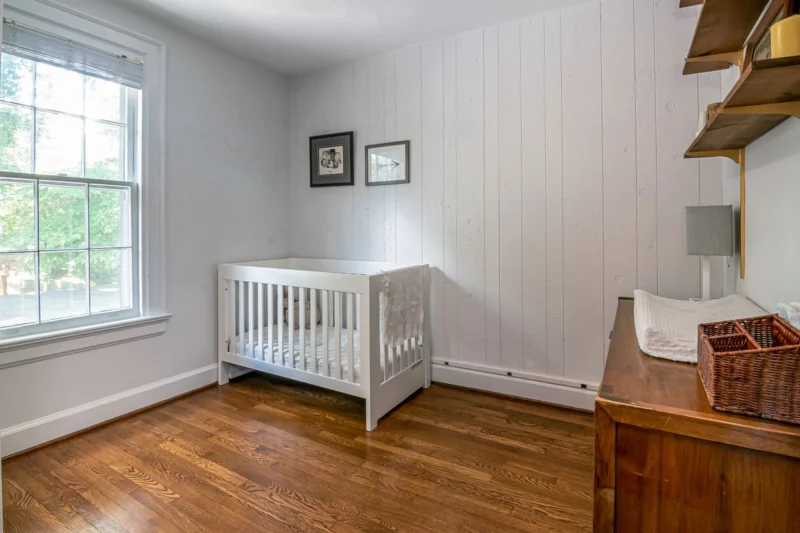
The cot should go away from the window, well clear of any blind cord or chain and out of direct sunlight. Government guidance says to keep cots, beds, highchairs and play pens away from blinds, and The Lullaby Trust advises not placing a baby’s cot in direct sunlight or near a heat source such as a radiator.
In practice this often decides the layout of the room before you think about blinds. Many nurseries are box rooms in terraces or 1930s semis, where the window takes up most of one short wall and the radiator sits under it. That leaves the opposite or side wall for the cot. Check where the sun falls at nap times too: a patch of afternoon sun can move across the floor and reach a cot that looked safely placed in the morning.
Remember that furniture moves as children grow. A chest of drawers or a bookcase under the window becomes a climbing frame for a toddler, which is one reason many parents choose to remove cords from the room entirely.
Can blinds help stop a nursery overheating?
Blinds can help stop a nursery overheating by reducing the sunshine that reaches the room, especially on south and west-facing windows. A blind with a pale or reflective backing, closed before the sun reaches the glass, keeps more heat out than one lowered after the room has warmed up. Ventilation still matters more than any blind.
The Lullaby Trust advises a room temperature of 16 to 20°C for a sleeping baby, and recommends a room thermometer for accuracy. In hot weather, its guidance is to use lighter bedding and clothing and open the bedroom door and a window, if it is safe to do so.
A blind supports that advice rather than replacing it. Some points that help:
- Close the blind early. Once sunlight has passed through the glass and warmed the room, a blind cannot remove that heat.
- Check the backing. A white or reflective back bounces more sunlight back through the window than a dark one.
- Keep the window usable. Make sure the blind can be lowered with the window open without the fabric flapping onto furniture or catching.
- Consider the loft room. Nurseries in loft conversions and dormer rooms can get very warm under the roof.
For more on handling heat in sunny rooms, see our guide to keeping a south-facing room cool.
Are cordless or motorised blinds better for a nursery?
Cordless or motorised blinds are better for a nursery in safety terms, because there is no cord or chain loop at all. A cordless blind is raised and lowered by hand using the bottom bar. A motorised blind uses a remote or switch, which is useful on high or awkward windows and when a sleeping baby is in the room.
| Operation | How it works | Nursery pros | Things to consider |
|---|---|---|---|
| Chain with safety device | Looped chain held taut by a tensioner fixed to the wall or frame | Familiar, simple, easy to adjust precisely | A loop is still present, and the device must stay fixed |
| Cordless | Pull the bottom bar down, push up to raise | No cord or chain in the room | You need to reach the bottom bar, which is harder over a deep sill or furniture |
| Motorised | Remote, wall switch or app | No cord or chain, quiet, can be operated from the door | Needs power or charging; keep remotes out of reach |
Many motorised systems can also open and close at set times; ask at your measure whether that suits your window. Our page on motorised roller blinds explains the options.
Should you layer blinds and curtains in a nursery?
Layering blinds and curtains in a nursery gives more darkness and more flexibility. A blackout roller blind fitted in the recess does the main work, and a curtain or a second blind in front covers the edge light and softens the look. It also means you can darken the room gradually rather than all at once.
Common combinations include:
- Blackout blind plus curtains. The blind blocks light through the glass, the curtain covers the gaps round the edges. Keep curtain tie-backs and any cords secured and out of reach too.
- Double roller blind. A blackout behind and a lighter dim-out or sheer in front, on separate brackets. This gives a bright but private room for daytime play and full darkness for sleep.
- Day and night blind. Alternating sheer and solid bands. It is not full blackout, so it suits older children more than toddlers who nap in summer.
Whatever you layer, the same rule applies to every cord, tie-back and loop in the room: keep it secured, tight and out of reach.
How to choose a nursery blind that grows with your child
To choose a nursery blind that grows with your child, pick a plain or softly patterned blackout fabric in a colour that will still suit a bedroom for an older child, with a safe operation that works at every age. The window, not the theme, should drive the choice. Themes change quickly; a good blind can last for years.
- Choose blackout fabric for the room’s main blind.
- Pick a neutral or mid-tone colour you would be happy with in a school-age child’s room.
- Check the backing colour and how it looks from outside.
- Choose cordless or motorised if possible; otherwise a chain with a fixed safety device.
- Decide the fit: an outside-recess overlap if darkness is the priority.
- Add personality with bedding, prints and paint, which are easier to change than a blind.
A wipeable fabric also helps. Small hands find blinds, and a fabric that can be sponged clean lasts better in a child’s room. Printed and character fabrics exist as a general option; ask at your measure whether they suit your window and whether you will still like them in a few years.
Common nursery blind mistakes
Common nursery blind mistakes include placing the cot under the window, leaving a chain loop hanging loose, choosing a pale dim-out for an east-facing room, forgetting that furniture becomes a climbing route for toddlers, and closing the blind only after the room has already heated up in summer.
- Fitting a safety device but not fixing it firmly to the wall or frame, so it can be pulled loose.
- Choosing a character print that the child outgrows in a year.
- Relying on a blind to cool a room instead of using ventilation and a thermometer.
- Forgetting the landing light under the door when trying to darken the room.
- Leaving old corded blinds in other rooms the child uses.
Help with nursery blinds locally
Help with nursery blinds locally starts with a free home measure. We cover London, Essex and North Kent, measure every window ourselves, and bring blackout fabric samples so you can see them against the nursery window. We can talk through cordless and motorised options and where the cot will go, and give a written quote with no obligation.
Our own team fits every blind, and chain-operated blinds are fitted with the safety devices required by BS EN 13120. If you are planning several rooms at once, our best roller blinds for bedrooms guide covers the other bedrooms in the house.
Key takeaways
- Blackout fabric gives you the choice of a dark nursery for naps and light summer evenings.
- Roll the blind fully up in the day; NHS guidance suggests open curtains by day and low lights at night.
- Choose cordless or motorised if you can. Chains must be held taut with a fixed safety device.
- Keep cots, beds and climbable furniture away from windows and out of direct sunlight.
- The Lullaby Trust advises 16 to 20°C for a sleeping baby; close blinds early on sunny days and use a thermometer.
- A neutral blackout outlasts a themed print.
Frequently asked questions
What are the best blinds for a nursery?
Blackout roller blinds are usually the best choice for a nursery, because they darken the room for naps and light summer evenings but roll fully up during the day. A cordless or motorised operation is the safest, as there is no cord or chain loop. Choose a neutral colour that will outlast the nursery years.
Are chain-operated blinds safe in a child’s room?
Chain-operated blinds should only be used in a child’s room with a safety device fixed firmly to the wall or frame so the chain stays taut. Government guidance also says to keep cots, beds and other furniture away from blinds. A cordless or motorised blind avoids the loop altogether and is the simplest option.
Do blackout blinds make a nursery hotter?
Blackout blinds do not make a nursery hotter by themselves. Closed early on a sunny day, a blackout blind with a pale or reflective backing reduces the sunlight warming the room. Dark backings absorb more heat at the glass. Ventilation and a room thermometer still matter most, as The Lullaby Trust advises.
What temperature should a nursery be?
The Lullaby Trust advises a room temperature of 16 to 20°C for a sleeping baby and recommends using a room thermometer. In hot weather, it suggests lighter bedding and clothing and opening the door and a window if it is safe. Keep the cot out of direct sunlight and away from radiators.
Should nursery blinds go inside or outside the recess?
For the darkest nursery, fitting outside the recess with an overlap on each side usually blocks more edge light than a recess fit. Inside the recess looks neater and suits windows with deep sills. At a measure, we check handles, sill depth and radiator position before recommending which fit suits the window.
Thinking about new blinds?
We measure and fit across London, Essex and North Kent. The visit is free and there is no obligation.