
Home › Conservatory roller blinds
Conservatory roller blinds, for the roof as well as the windows
If your conservatory is too hot to sit in by June, the roof is the reason, not the windows. Blinding the sides alone is the most common and most expensive mistake people make, and this page explains why before you spend the money.
- Roof and side blinds
- Measured pane by pane
- Motorised and sensor options
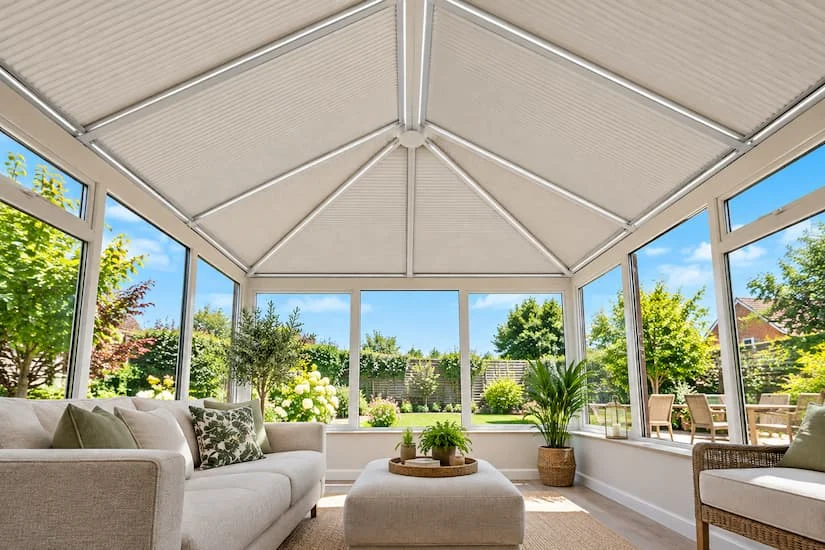
The roof is the problem
In midsummer the sun sits high in the sky, so it strikes a conservatory roof almost square on and the side windows at a shallow angle. The roof is therefore taking the overwhelming majority of the solar energy entering the room. It is also, in most conservatories, the largest single area of glazing.
Which is why fitting blinds to the windows and leaving the roof bare rarely fixes anything. The room still overheats, the customer concludes that blinds do not work, and a few hundred pounds has bought very little.
If you only do one thing, do the roof. On a budget, roof blinds alone will transform how usable a conservatory is in summer. Side blinds alone will not. We would rather quote you for a partial job that works than a full one that disappoints.
Roof blinds and side blinds are different products
They look similar in a brochure and behave completely differently.
| Roof blinds | Side and window blinds | |
|---|---|---|
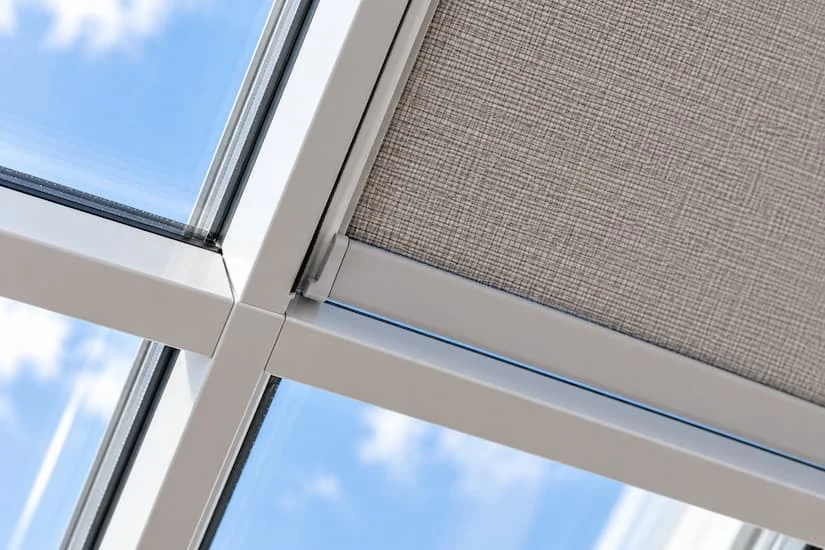
| The engineering | Fabric held under tension in channels along the glazing bars, so it cannot sag away from the glass. | Conventional roller blinds hanging vertically. |
| Main job | Blocking solar heat before it enters the room. | Glare control and privacy. |
| Cost | Substantially more per pane: more components and far more labour. | Similar to any other window blind. |
| Operation | Motorised is strongly preferable. They are overhead and out of reach. | Chain, cordless or motorised. |
Gravity is the whole difference. A vertical blind hangs straight by itself; a sloped blind has to be pulled taut and guided, or it drops away from the glass and looks like washing on a line. That tensioning system is why roof blinds cost what they do.
Which fabric, and why colour matters more here
For the roof, a solar or sunscreen fabric in a light colour. Two reasons:
- Light reflects. A pale fabric bounces solar radiation back out through the glass. A dark one absorbs it and re-radiates a good share of that heat downwards into the room, which is exactly what you are trying to prevent.
- It stays usable. A blackout fabric in a conservatory roof turns a glass room into a dark box. People stop using the room, which is a different way of failing.
This runs against instinct, dark fabrics feel like they should block more, and it is the advice we most often have to explain twice. For a roof, choose pale.
For the sides you have more freedom:
- Solar for glare and low evening sun, keeping the garden view.
- Day and night where the conservatory is overlooked and you want privacy after dark.
- Thermal if the room is unusable in winter as well. A conservatory loses heat as fast as it gains it.
What we check on site
The roof construction
Glass or polycarbonate, and how the glazing bars run. Blinds are measured and fitted pane by pane between the bars, so the bar spacing sets the number of blinds. Polycarbonate roofs run hotter and are noisier in rain than glass, and they are also the ones people most often want blinded.
Lanterns and roof shapes
A roof lantern on a flat-roofed extension is a different job from a pitched conservatory roof, usually four sloping faces meeting at a ridge, each needing its own blinds. Victorian and Edwardian conservatory roofs have angled corner panes that are not rectangular, and each one has to be measured individually.
Whether you actually need roof blinds
If your conservatory has been converted to a solid or tiled roof, you do not: the overheating problem has already been solved and side blinds alone are the right answer. Some newer conservatories have solar-control glass in the roof, which reduces the problem without eliminating it. We will tell you which situation you are in rather than quoting for blinds you may not need.
Access
Roof blinds are fitted at height, working overhead. On a tall or steeply pitched roof that affects how long the job takes and occasionally what equipment is needed. Better established at the measure than on the morning of the fit.
Motorising the roof
For roof blinds this is close to essential rather than a luxury. They are above head height and cannot be reached, and the whole point is that they close when the sun is on them, which is often when nobody is in the room.
A sun sensor closes the roof blinds automatically when the sun hits the glass, so the conservatory never gets the chance to heat up in the first place. That is the difference between a room that is bearable when you remember to close the blinds and one that is simply usable.
Power matters here too: a battery motor on a roof blind means reaching it to recharge, which is the thing you were trying to avoid. On a conservatory roof we would normally recommend hardwiring or, where the glass gets good sun, solar charging. See motorised roller blinds.
Honest expectations
We would rather set these now than have the conversation in August.
- Blinds reduce heat. They do not air-condition. A well-blinded conservatory on a thirty-degree day will be cooler than the garden and warmer than the house. That is a good outcome, and it is not the same as cool.
- Ventilation does half the work. Roof vents, open doors and a through-draught matter as much as the blinds. Heat that is already in the room has to be able to leave it.
- Winter is a separate problem. Blinds slow heat loss but a single-skin glass room will always be cold in January. Thermal fabrics help; they do not turn it into a lounge.
- A full conservatory is a significant cost. Roof and sides together is one of the larger jobs we quote for domestically. Doing the roof first and the sides later is a perfectly sensible way to spread it, and it puts the money where the effect is.
Cleaning and lifespan
Roof blinds live in the hottest, brightest part of the house, and fabrics there work harder than anywhere else. Choose a quality solar fabric rather than the cheapest available, on a roof, a fabric that fades or goes brittle is a genuinely awkward thing to replace.
Dust settles on the upper surface of roof blinds where you cannot see it. Lower them fully once or twice a year and vacuum gently on low suction. Side blinds clean like any other roller.
What it costs
The roof is where the money goes
Side blinds price like any other window blind. Roof blinds cost considerably more per pane, because of the tensioning system, the additional components and the labour of working overhead.
Number of panes, roof shape, fabric and whether you motorise all move the figure, so we do not publish a conservatory price: it would be meaningless. We measure, then quote in writing, itemised so you can phase the work if you want to.
Related
Worth reading alongside
Sunscreen & solar
The fabric doing the work. Openness factor and why pale wins on a roof.
Read moreSkylight & Velux
Individual roof windows, same tensioning problem, smaller job.
Read moreMotorised
Sun sensors, and why battery power is the wrong choice on a roof.
Read moreFrench & patio doors
Most conservatories open onto the garden. How we treat the doors.
Read more


