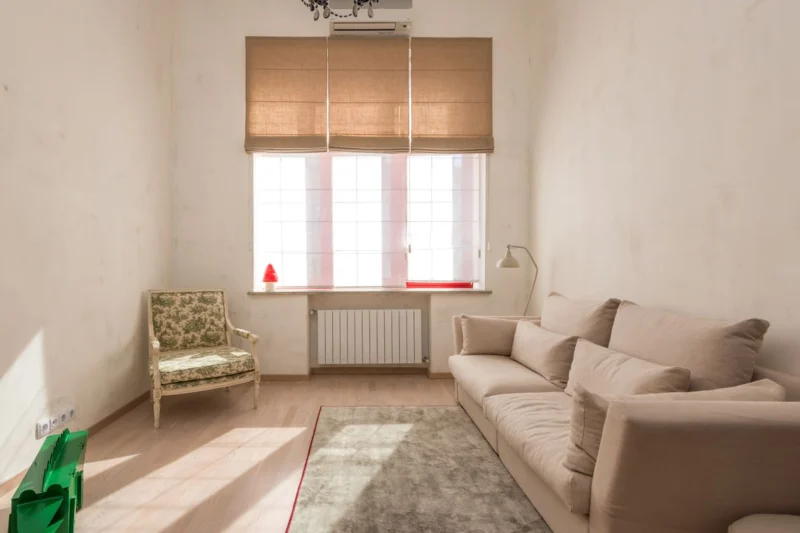
Floor-to-ceiling glass looks brilliant on the viewing day and then becomes a problem on the first sunny afternoon. Tall windows and Juliet balcony doors need blinds that cope with size, weight, handles and a lot of light, all at once.
Quick answer: The best blinds for floor-to-ceiling windows and Juliet balconies are usually made-to-measure roller blinds, split into two or three blinds across wide glass and fixed to the ceiling or above the frame. Use sunscreen fabric in living areas for glare and daytime privacy, blackout in bedrooms, and consider motorisation for very tall or heavy blinds.
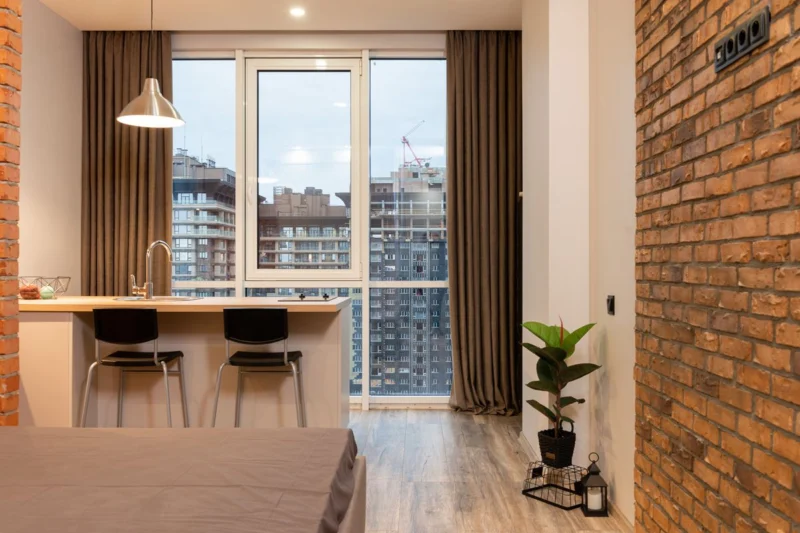
What are the best blinds for floor-to-ceiling windows?
Blinds for floor-to-ceiling windows need to be strong enough for a long drop, simple enough to operate every day and neat enough to sit against a large expanse of glass. Made-to-measure roller blinds suit this well because the fabric rolls away into a compact tube at the top, leaving the full view when you want it.
Tall glazing magnifies small problems. A blind that is slightly too narrow leaves a bright strip of light down each side. A chain that was fine on a normal window can end up long enough to trail on the floor. A cheap tube that copes with a metre of fabric can sag across a wide span. That is why size, fixing position and operation matter more here than on a standard bedroom window.
How wide and how tall can a single roller blind be?
Roller blind size limits depend on the fabric roll width, the fabric weight and the strength of the tube. Every fabric is cut from a roll of fixed width, and heavier or wider blinds need a larger tube and stronger controls. Past a certain point, two or three blinds side by side work better than one.
There is no single number that applies to every blind. A light sunscreen fabric can often be made wider than a heavy blackout, and a very long drop adds weight that the tube and operating mechanism have to carry every time you raise it.
When we measure a large window, we check the fabric you like against the width and drop you need before we quote. If one blind would push the limits, we say so on the day rather than letting you find out when it sags or struggles to roll.
Signs one blind is the wrong choice
- The fabric you want is not made in a width that covers the whole opening.
- The blind would be heavy enough to make a chain hard work to pull.
- The window has a mullion or a door within the run that needs to open separately.
- Only part of the glass needs shading at certain times of day.
Should you use one blind or split tall glass into two or three?
Splitting floor-to-ceiling glass into two or three roller blinds is usually the better choice when the window is very wide, contains an opening door, or is divided by frame mullions. Separate blinds are lighter to operate, can follow the frame lines, and let you shade one section while leaving another open.
The simplest way to decide is to look at the frame. If the glass is divided into panels, lining a blind up with each panel tends to look deliberate and leaves each blind easy to use. If one of those panels is a door onto a Juliet balcony, giving it its own blind means you can open the door without raising the blinds on the fixed glass either side.
Linked systems
Linked roller blinds put two or more blinds on shared brackets so they raise and lower together from one control. They suit a long run of glass where you always want the blinds at the same height, such as a living room wall. They are less useful when one section is a door you want to use independently. Motorised blinds can do a similar job with a group setting on a remote, while still letting you move each blind on its own.
| Option | Best for | Watch out for |
|---|---|---|
| One large blind | Moderate widths with no opening door in the run | Fabric width limits, weight and sagging on very wide spans |
| Two or three separate blinds | Glass divided by mullions, or a door within the run | Small light gaps between blinds |
| Linked blinds | Long runs you always want at the same height | Sections cannot move independently |
| Motorised blinds | Very tall, heavy or hard-to-reach blinds | Needs a power plan (battery or mains) |
Should blinds on floor-to-ceiling windows be fixed to the ceiling or the frame?
Ceiling fixing is often the neatest option for floor-to-ceiling windows because there is little or no wall above the glass. Fixing to the top of the frame can work when the frame is deep and strong enough. The right choice depends on what is above the window and how much clearance the handles need.
In many new-build flats the glazing runs right up to a plastered ceiling, so there is nowhere else to go. A ceiling fix lets the fabric drop straight down in front of the frame, covering the full width and cutting down light around the edges. It also keeps the roll tight to the top of the room, which looks cleaner than a blind perched on the frame.
Fixing into the frame is sometimes possible on aluminium or uPVC systems, but it needs care. Screws must avoid drainage channels, reinforcement and glazing beads, and in many flats the frame may form part of the building’s warranty or be controlled by the freeholder or managing agent. If you lease a flat, check your lease or ask the managing agent before anyone drills into the window system.
What we check before fixing
- What the ceiling or wall is made of, and whether it can take the weight.
- Whether there is a bulkhead, curtain pelmet or trickle vent in the way.
- How far the handles, locks and hinges stick out from the glass.
- Whether radiators, sockets or furniture sit near the bottom of the drop.
How do you fit blinds on a Juliet balcony door without catching the handle?
Juliet balcony door blinds need enough clearance between the fabric and the door handle, so the blind can roll up and down without rubbing or snagging. This usually means fixing the blind outside the recess, on the ceiling or wall, far enough forward to clear the handle, or using a separate blind for each opening door.
Juliet balconies are mostly French doors or single doors opening inwards, with a glass or metal rail on the outside. Because the doors open into the room, a blind fixed to the door frame itself is rarely practical: it would have to move with the door or clear the sash when opened. Most people want the blind to roll up fully and then open the doors normally.
When we measure these doors, we check the handle projection and the swing of each door, then set the brackets so the fabric falls in front of everything that sticks out. We also look at whether the blind, when fully raised, will sit above the top of the opening doors so it does not block them. Our guide to roller blinds for French and patio doors covers the fixing options in more detail.
Common mistakes with Juliet balcony blinds
- Measuring the glass only and forgetting the handle, so the fabric rubs every time.
- Fitting inside a shallow reveal where the roll stops the door opening fully.
- Choosing one wide blind that has to be raised just to step onto the balcony threshold.
- Leaving a long chain loose near a door that children use.
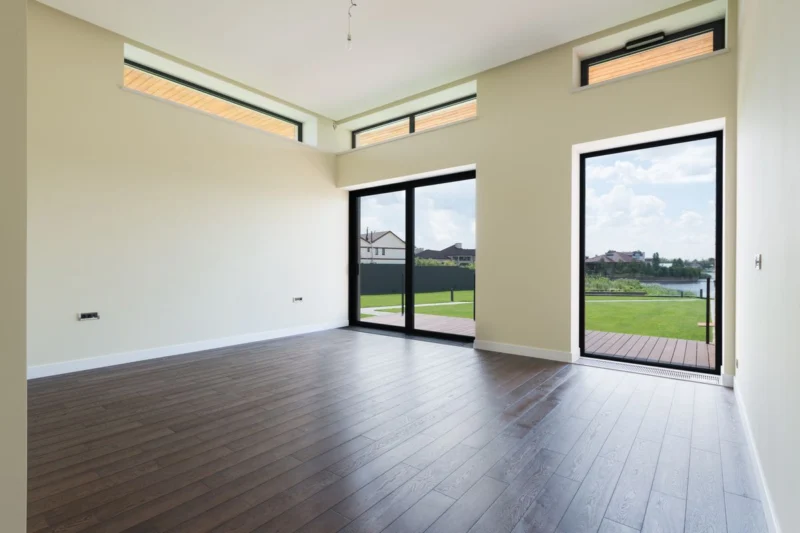
How do you stop glare and keep privacy in a high-rise flat?
Glare and privacy in a high-rise flat are best handled with sunscreen roller blinds during the day. Sunscreen fabric cuts glare on screens and reduces heat build-up while keeping a view out. Privacy from outside depends on light levels, so at night, when your room is brighter than outside, you need a denser fabric.
Flats on upper floors often have fewer neighbours looking straight in, but they get strong, low sun across large panes, especially on south and west facing elevations. That sun bounces off TV and computer screens and warms the room quickly. A sunscreen roller blind reduces that glare while you can still see the skyline through the weave.
The important thing to know about sunscreen fabric is how privacy flips at night. By day, the bright exterior makes it hard for people outside to see in. After dark, with the lights on inside, the effect reverses and people outside can see through more easily. If you are overlooked by other blocks, pair sunscreen with a dim-out or blackout option for evenings, or choose a day and night fabric that switches between the two.
Internal blinds do help with comfort, but they are not a design solution for overheating in new homes. The government’s Approved Document O on overheating states that internal blinds and curtains should not be counted when a new building shows it meets the overheating requirement. In practice, a blind helps with glare and some heat, while ventilation and the building’s design do the heavy lifting.
Sunscreen, blackout or day and night: which fabric for which room?
The right fabric for floor-to-ceiling windows depends on the room. Sunscreen suits living rooms and home offices where you want the view and less glare. Blackout suits bedrooms, particularly in city flats with street lighting and early summer sunrises. Day and night fabric suits rooms needing both, with alternating sheer and solid bands.
| Fabric | What it does | Best rooms |
|---|---|---|
| Sunscreen (solar) | Reduces glare and heat, keeps an outward view by day | Living rooms, kitchens, home offices |
| Dim-out / light filtering | Softens light and gives privacy, does not fully darken | Living rooms, dining areas |
| Blackout | Blocks light through the fabric for sleep and screens | Bedrooms, nurseries, media rooms |
| Day and night | Two layers of sheer and solid stripes you align for view or privacy | Open-plan living, bedrooms that double as workspaces |
| Thermal | Adds a layer between room and glass to reduce heat loss and gain | North-facing rooms, large single-glazed areas |
On very tall glass, remember that blackout fabric only blocks light through the fabric itself. Light still gets in around the edges, so a ceiling fix with generous overlap each side gives you a much darker room than a blind fitted tight inside the frame. For a bedroom with a Juliet balcony door, fixing above and wider than the opening makes the biggest difference.
Are motorised blinds worth it for tall or large windows?
Motorised roller blinds are often worth it on tall or large windows because they remove long chains, make heavy blinds effortless and let you operate several blinds together. They are particularly useful where the top of the blind is out of reach, where furniture blocks the window, or where young children live.
A chain on a floor-to-ceiling blind has to be long enough to reach, which means a lot of chain. Any looped chain must be fitted with the child safety devices required by BS EN 13120, and on tall windows that tensioner usually sits low on the wall or floor. A motor avoids the chain entirely.
Motorised blinds also make it easy to group blinds. One button can bring down every blind along a glazed wall, or you can move each one individually. Battery motors avoid chasing cables into walls, which matters in rented or leasehold flats, while mains-powered motors suit a renovation where an electrician is already on site.
If you are weighing the cost against manual blinds, our page on motorised roller blinds explains the power options and controls.
How do you measure floor-to-ceiling windows for blinds?
Measuring floor-to-ceiling windows for blinds means recording the full width and drop you want to cover, plus anything that affects fixing: ceiling height, bulkheads, handles, sills, skirting and heating. On large glazing it is worth having a professional measure, because an error of a few millimetres across a wide span is easy to spot.
- Decide on the fixing: ceiling, wall above the frame, or top of the frame.
- Measure the width you want covered at the fixing point, adding overlap on each side if fitting outside the frame.
- Measure the drop from the fixing point to where you want the fabric to stop, usually just above the floor.
- Measure at several points, as ceilings in new-build flats are not always perfectly level.
- Note how far handles project and how doors swing.
- Photograph the window and surroundings so nothing is forgotten.
Getting blinds for tall windows in London, Essex and North Kent
Local help for floor-to-ceiling windows starts with a free home measure. HD Blinds measures every window, brings fabric samples so you can see them against your own light, and gives a written, no-obligation quote. Our own team fits the blinds across London, Essex and North Kent.
Large glazing is common in the newer apartment blocks around Stratford, Canary Wharf and Greenwich, where Juliet balconies, tilt-and-turn doors and glass running to the ceiling are the norm. The same principles apply to glazed extensions on older houses in Essex and North Kent: plan the split, the fixing and the fabric together, and the blinds will look as though they were designed with the room.
Key takeaways
- Split very wide glass into two or three blinds that follow the frame lines.
- Ceiling fixing is often the neatest option when glass runs to the ceiling.
- Check handle projection and door swing on Juliet balcony doors before choosing brackets.
- Use sunscreen by day in living areas and blackout or day and night where privacy after dark matters.
- Motorisation removes long chains and makes heavy blinds easy to operate.
Frequently asked questions
Can you get one roller blind for a very wide window?
Sometimes, but it depends on the fabric roll width, fabric weight and tube strength. Very wide or heavy blinds can sag or become hard to operate. Two or three blinds lined up with the frame usually look neater, weigh less and let you shade part of the glass while leaving the rest open.
What blinds work on a Juliet balcony door?
Roller blinds fixed on the ceiling or wall above the doors usually work best. They sit forward of the handles, roll up above the opening doors and cover the glass fully. Giving each door its own blind lets you open one side without raising blinds over the fixed glass nearby.
Do sunscreen blinds give privacy at night?
Not fully. Sunscreen fabric gives good daytime privacy because it is brighter outside than inside. At night, with your lights on, people outside can see in more easily. Pair sunscreen with a blackout or dim-out blind, or choose day and night fabric, if you are overlooked after dark.
Can blinds be fitted to a ceiling?
Yes. Ceiling fixing is common with floor-to-ceiling glass because there is often no wall above the frame. The ceiling must be able to take the fixings and the blind’s weight, and the brackets need to sit far enough forward to clear handles, trickle vents and any bulkhead.
Are motorised blinds better for tall windows?
Often, yes. Motors remove long chains, make large blinds easy to raise and let you group several blinds on one control. Battery motors avoid cabling, which suits flats. A manual chain or cordless blind can still be fine on smaller windows you can reach comfortably.
Thinking about new blinds?
We measure and fit across London, Essex and North Kent. The visit is free and there is no obligation.