
Home › Roller blinds for French & patio doors
Roller blinds for French, patio and bi-fold doors
A door is a window that moves, which changes everything. The blind has to clear the handle, survive the door opening and closing several times a day, and not swing about while it does it. Three problems, and they are all solvable, but only if someone thinks about them before ordering.
- Blinds that move with the door
- Fixing options discussed at the measure
- Handle clearance checked
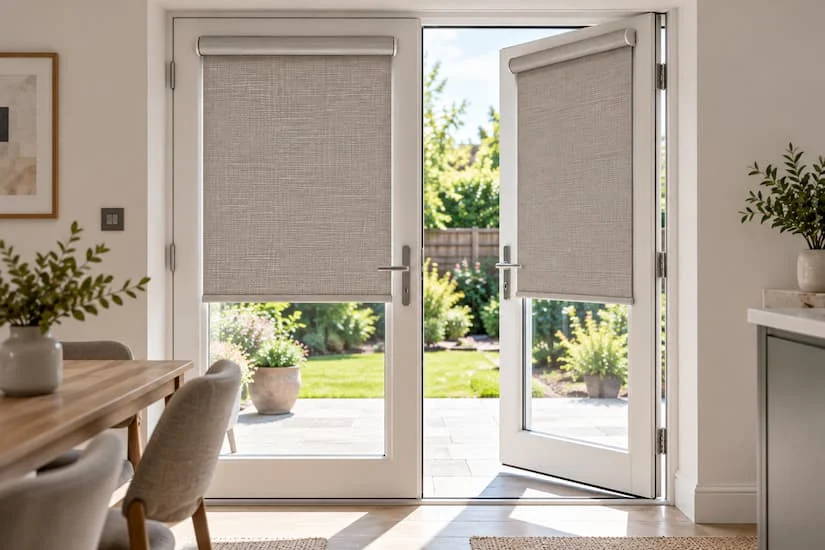
The three problems a door creates
1. The handle gets in the way
Door handles project further into the room than window handles do, and they sit right where a blind wants to hang. A blind fitted without measuring the handle projection will either foul it or press against it every time the door is used.
2. The blind swings
This is the one people underestimate. A blind fitted to a door that opens will swing out from the glass every time the door moves, flapping against the frame and eventually damaging the fabric edges. A blind hanging loose on a door is a blind that will annoy you daily.
3. The door has to keep working
Obvious and regularly overlooked. On inward-opening French doors, a blind fitted above the opening will catch on the door as it swings in. On sliding patio doors, a blind hung across the whole opening has to be raised before you can go outside, which defeats the point of having it down.
The question that decides everything: does the blind stay still while the door moves, or does it travel with the door? Answering that first is what separates an installation that works from one you end up living around.
The two approaches
| One blind per door leaf | One blind across the opening | |
|---|---|---|
| Where it fits | Onto the door frame itself, so it moves with the door. | Above the whole opening, on the wall or in the reveal. |
| Door use | Door opens normally with the blind down. No need to touch it. | Blind must be raised before the door can be used. |
| Look | Follows the door, sits tight to the glass, very neat. | One clean sweep across the opening. Good on wide spans. |
| Best for | French doors, bi-folds, any door used daily. | Sliding patio doors, or a run of glass where only one section opens. |
| Watch out for | Handle clearance, and fixing method on uPVC. | Blind catching on inward-opening doors; stacking bulk on very wide openings. |
For French doors used every day onto a garden, blinds on the leaves are almost always the better answer. For a patio slider that is only opened in summer, a single blind across the opening often looks better and costs less.
Keeping the blind against the glass
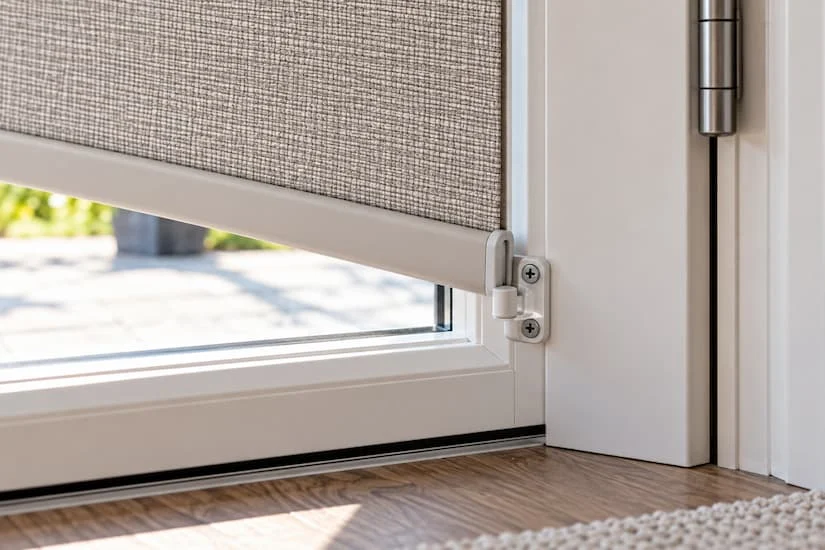
If the blind travels with the door, it has to be held so it cannot swing. There are two ways, and we will recommend one at the measure.
- Hold-down brackets. Small clips at the bottom of the door that the bottom bar locates into. Simple, cheap, effective. The blind is held top and bottom so it moves as one with the door.
- Side channels. The fabric edges run inside slim tracks down each side of the glass. Holds the blind completely flat, and as a bonus closes the light gaps, which matters if you want a blackout fabric on a door.
Without one or the other, a blind on a moving door is a mistake you notice within a week.
Fixing to uPVC without drilling
Most modern French and patio doors are uPVC or aluminium, and people are understandably reluctant to drill into a sealed frame, on a door still under warranty, drilling can invalidate it.
We check the frame at the measure and show you exactly where each bracket would go before anything is drilled.
Where we do drill uPVC, we drill into the frame, never the glazing bead or the sealed unit, and we will say so before starting.
Door by door
French doors
A pair of hinged doors, usually opening inward in older properties and outward in newer ones. The standard answer is a blind on each leaf, fixed to the door and held with hold-down brackets or channels, so both doors work normally with the blinds down.
Inward-opening doors rule out a blind above the opening: the door will catch it. Outward-opening doors give you both options, and then it is a question of look and budget.
Where there are fixed side panels flanking the doors, we usually blind those separately in the same fabric, so the whole elevation reads as one treatment.
Sliding patio doors
Nothing swings, so a single blind across the full opening works well and looks clean. The catch is that you must raise it to go outside: fine for a door used occasionally, irritating for one used constantly in summer.
The alternative is a blind per panel, so the fixed pane stays covered while the sliding pane is clear. Slightly busier, far more usable. Tell us how often the door is actually opened and we will advise accordingly.
Where the opening is very wide, a single blind becomes heavy and the roll at the top becomes bulky. Splitting it into two or three is usually better, and we will say where that point falls on your door.
Bi-fold doors
The hardest of the three, because every leaf folds against its neighbour. Blinds must be slim enough that the doors still stack fully, and each blind has to be held flat so it does not catch as the leaves concertina.
One blind per leaf with side channels is the reliable solution. A single blind across the opening also works, but it has to be fully raised before the doors can fold, which on a bi-fold, the whole point of which is opening up the wall, rather misses the idea.
Single back doors and side doors
The simplest case: one blind on the door leaf with a hold-down bracket. Worth specifying a wipe-clean fabric on a back door that gets used with muddy hands, and a moisture-resistant fabric if it opens off a utility room.
Which fabric for a door
Doors are usually the largest area of glass in the room, which changes what the fabric has to do.
- Sunscreen: the most common choice. Garden doors face the sun and you still want to see out. A 5% openness cuts glare and heat while keeping the view that the doors exist for.
- Day and night, for doors overlooked by neighbours. The view during the day, privacy in the evening, on one chain.
- Blackout, for a bedroom with a Juliet balcony or doors onto a terrace. Specify side channels; without them the light gaps down a full-height door are considerable.
- Thermal: a large glazed door loses a lot of heat on a winter evening. Worth considering on a north-facing set.
Options that suit doors
Motorised
Especially good on bi-folds and wide sliders, where several blinds move together and reaching the far end means walking round furniture. See motorised roller blinds, and note that a door blind is usually easy to reach for charging, which makes battery power a practical choice here.
Cassettes
On a door the head of the blind is at eye level as you walk through it, so an exposed roller is more visible than it would be on a window. A cassette tidies it and protects the mechanism from knocks in a doorway.
Child safety
Door blinds hang at full height, so a chain runs the whole length of the door: within easy reach of a small child, and beside a door they may be standing at. This is a strong case for cordless or motorised. See child-safe roller blinds.
What goes wrong
- The blind fouls the handle. Projection never measured.
- The blind swings. No hold-down bracket or channel fitted.
- The door will not open with the blind down. A single blind fitted above inward-opening French doors.
- Bi-folds will not stack. Blinds too bulky for the leaves to fold flat against each other.
- Drilled into the glazing bead. Or into the frame of a door still under warranty, without anyone raising it first.
What it costs
Priced per blind, plus the fixings
A pair of French doors is two blinds. A three-panel bi-fold is three. Hold-down brackets add very little; side channels cost more per blind but do a better job and are what we would specify with a blackout fabric.
We quote per blind in writing after measuring, with the fixing method stated so you know what is holding it to the door.
Related
Worth reading alongside
Sunscreen & solar
The usual choice for garden doors. Keeps the view, cuts the glare.
Read moreConservatory blinds
Doors are usually part of a larger glazed run. How we treat the whole space.
Read moreMotorised
Several door blinds moving together, without walking the length of the room.
Read moreChild-safe & cordless
A full-height chain beside a door is worth removing altogether.
Read more


