
Home › Commercial & fire-retardant roller blinds
Commercial roller blinds, specified properly
Fire-retardant fabrics with the test certificates to prove it, contract-grade components, and installation scheduled around your building rather than ours. Offices, schools, nurseries, healthcare, hospitality and industrial: across East London, Essex and Kent.
- BS 5867 Part 2 fabrics
- Certificates supplied
- Out-of-hours fitting
Fire performance: what to specify
The relevant standard for blind and curtain fabrics is BS 5867-2:2008, which sets flammability requirements for fabrics used in curtains, drapes and window blinds. It is divided into types, and the difference between them is not marginal: specifying the wrong one is the most common error we see on commercial enquiries.
| Type | What the test covers | Where it is normally specified |
|---|---|---|
| Type A | The baseline. A ten-second flame application to a vertically mounted specimen, tested to BS EN ISO 6941. | Minimum compliance level. Rarely the right answer on its own for a public building. |
| Type B | Type A performance retained after 12 standard wash cycles at 75°C, line dried. The test looks at whether flame reaches the specimen edges and whether flaming debris falls. | Offices, hotels and public buildings. The usual commercial specification. |
| Type C | The most demanding. Everything in Type B, plus after-flame and afterglow times measured, and performance retained after 50 wash cycles at 75°C with tumble drying. | Hospitals and healthcare environments. |
The durability point is the one people miss. The difference between Type B and Type C is largely how many wash cycles the fabric must survive while keeping its fire performance: 12 against 50. That is a durability requirement, not just a flammability one, which is why healthcare specifies it and a standard office does not need to.
Tell us the building type and its use, and we will specify to match. If your specification, fire risk assessment or insurer names a particular type, send it over and we will quote against it exactly rather than approximately.
Certificates
We supply the fabric test certification with the job, so it goes straight into your building file. If you have been offered fire-retardant blinds by anyone who cannot produce the certificate for the specific fabric, that is worth pausing on: "FR" on a website is a claim, and the certificate is the evidence.
Inherently FR or treated?
Some fabrics are inherently flame-retardant, meaning the property is built into the fibre and does not wash out. Others are treated, where a finish is applied and can degrade over time and with cleaning. For a long-life installation, or anywhere the blinds will be cleaned regularly, inherently FR is the safer specification. We will tell you which a given fabric is rather than letting "FR" cover both.
Sectors we fit
Offices
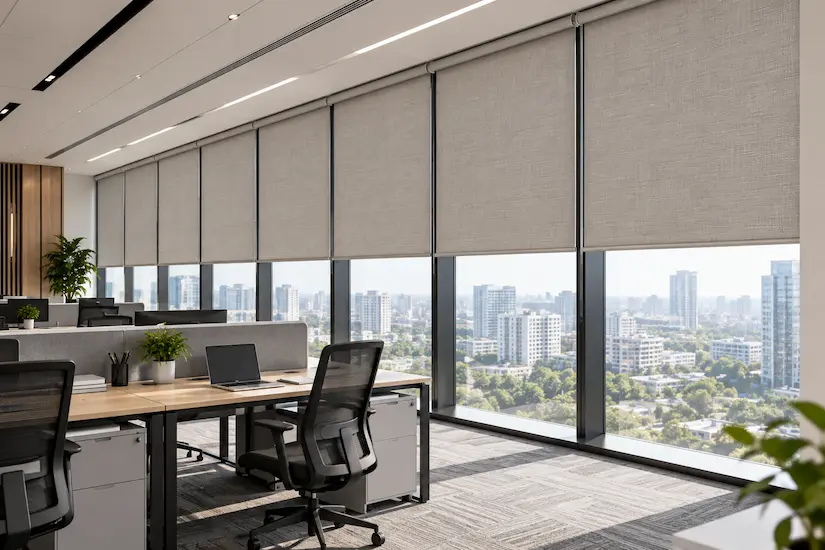
Usually glare control first and appearance second. A sunscreen fabric at 3% or 5% openness in a Type B grade handles screen glare while keeping the elevation looking consistent from outside, which matters, because landlords and building managers care how a facade reads from the street. Uniform fabric and colour across every window is normally part of the lease requirements; check yours before choosing.
Schools and nurseries
Two requirements at once. Fire performance to the specification, and cord safety: the child safety standard applies in full to all public buildings and to commercial areas where children under 42 months are present. In education settings we normally specify cordless or motorised throughout rather than relying on devices that staff may not know to check. See child-safe roller blinds.
Healthcare and care homes
Type C fabrics, wipe-clean surfaces and mechanisms that tolerate frequent cleaning. Infection control usually drives the fabric choice as much as fire performance does, and antimicrobial finishes are available where required. Tell us the cleaning regime and we will specify to survive it.
Hospitality
Hotels, restaurants and bars need appearance and compliance in equal measure, and blackout in bedrooms. Type B is the normal requirement. For guest rooms, see blackout roller blinds: the fitting method matters more than the fabric for getting a room properly dark.
Industrial and warehouse
Large spans, high level glazing and heat rather than aesthetics. Solar fabrics to cut heat gain, motorised because nothing at that height gets adjusted by hand, and robust components.
Retail
Sun protection for stock and displays, and glare control for staff at tills. Solar fabrics block a substantial share of UV, which slows fading of anything on display near the glass.
How a commercial job runs
Different from a domestic fit, mostly in the planning rather than the fitting.
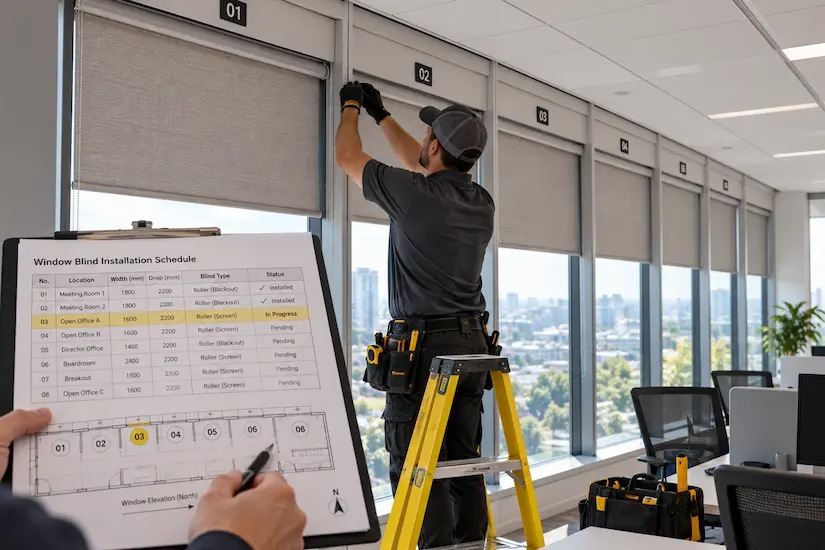
- Site survey. We measure every window on site rather than working from a drawing, because glazing rarely matches the plan exactly and a schedule built on assumptions produces blinds that do not fit.
- Written schedule. Every window numbered, with fabric, size, control type and side of operation listed. You approve it before anything is ordered, and it becomes the record for future maintenance.
- Specification and certificates. Fabric grade confirmed in writing, certification supplied with the job.
- Installation around your operation. Evenings, weekends or phased floor by floor. We would rather work at an awkward hour than shut a floor down.
- Handover. Controls demonstrated, safety devices shown and explained, instructions left with the facilities contact rather than on a windowsill.
Paperwork
For larger sites we can provide RAMS, and our fitters carry the appropriate site cards. If your building requires specific documentation or an induction before we attend, tell us at enquiry stage and we will have it ready rather than turning up and being sent away.
Specification decisions worth getting right
Fabric openness on glazed elevations
On a fully glazed office floor, openness factor changes the feel of the whole space. Too tight and the room goes gloomy and staff raise the blinds, defeating the point. Too open and the glare problem remains. 5% suits most offices; 3% where the sun is direct and screens are the issue.
Uniformity from outside
If blinds are visible from the street, the building looks best when every one is the same fabric and colour and sits at a consistent height. Many leases require it. Worth confirming before a floor is ordered in a different shade to the one above.
Cassettes on exposed fixings
In a finished commercial interior an open roller looks unfinished. A cassette or fascia tidies the head detail and protects the mechanism in a high-traffic space.
Control side and grouping
Sounds trivial, matters daily. Chains on the wrong side end up behind a desk or a radiator and never get used. Motorised blinds grouped by elevation rather than by room let you shade the sunny side of a building in one action.
Maintenance and replacement
Commercial blinds get used harder than domestic ones. Keep the schedule, so a damaged blind can be replaced in matching fabric years later without re-surveying the building. We hold job records for this reason.
Quoting
Send us the schedule, or we will make one
If you have a specification or a window schedule, send it and we will price against it line by line. If you have a building and no paperwork, we will survey it and produce the schedule as part of the quote.
Either way you get a written, itemised quotation per window, with the fabric and grade named so it can be checked against your requirements.
Related
Commonly specified alongside
Sunscreen & solar
The default office fabric. Openness factor explained.
Read moreChild-safe & cordless
Required in schools, nurseries and public buildings.
Read moreMotorised
High level glazing, grouped control, timers and sun sensors.
Read moreWaterproof
Commercial kitchens, wet areas and washroom facilities.
Read more


