
Home › Skylight & Velux roller blinds
Skylight and Velux roller blinds, held flat to the glass
A blind on a sloping window has gravity working against it. Without side channels holding the fabric under tension, it sags away from the glass, lets light round the edges and will not stay where you put it. Getting that right is most of this job.
- Tensioned side channels
- Blackout for loft bedrooms
- Velux and other roof windows
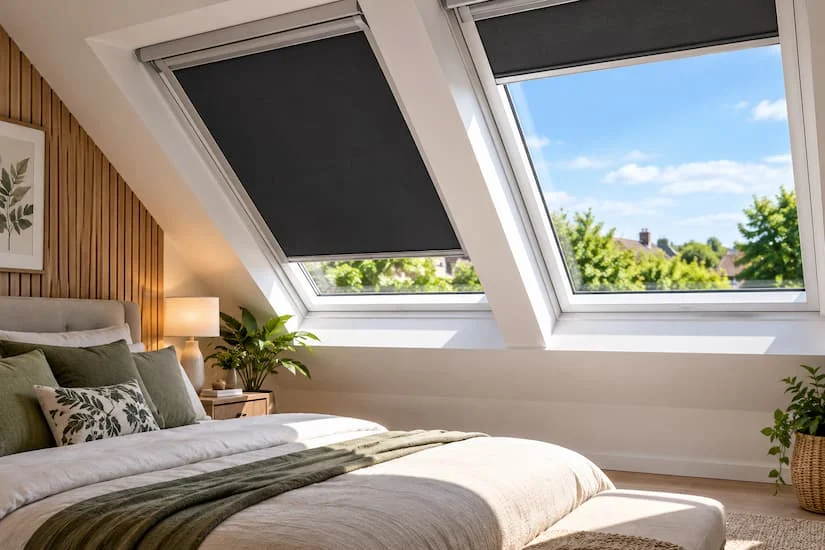
Why a roof window is different
Hang a roller blind on a vertical window and gravity does half the work: the fabric falls straight and stays against the glass. Tilt that window back to forty-five degrees and gravity stops helping and starts pulling the fabric away from the frame.
So a skylight blind cannot simply be a normal roller turned on its side. It needs:
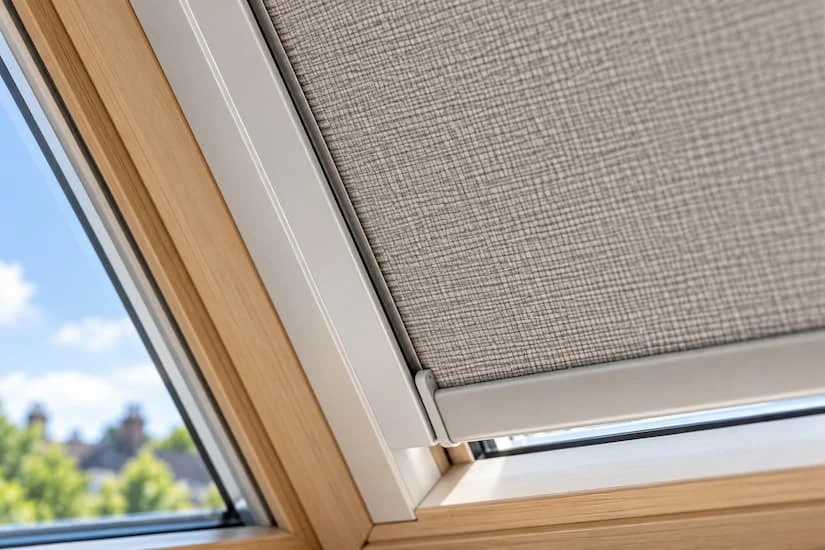
- Side channels running down both sides of the glass, with the fabric edges captured inside them.
- Tension in the system, so the blind holds at any position instead of sliding down under its own weight.
- A bottom bar that locates, so it stops where you leave it rather than drifting.
That is why a roof window blind costs more than a standard blind of the same size. You are paying for the mechanism that beats gravity, not for the fabric.
Side channels are not an upgrade here, they are the product. If you are offered a skylight blind without them, it will sag within weeks and leak light down both sides from day one. On a sloping window, this is the part that matters.
Blackout, and why loft bedrooms need it most
Roof windows face the sky rather than the horizon, so they catch light earlier and for longer than a vertical window in the same room. A loft bedroom with an unblinded roof window gets light at first summer dawn, and in June that is very early indeed.
The good news is that a channelled roof blind is the closest thing to true blackout we fit. The fabric edges sit inside the channels, so there is no side gap at all: the light-leak problem that blackout blinds on ordinary windows always have is solved here by the mechanism itself.
Loft conversions and children's attic bedrooms are the single most common reason people call us about roof blinds.
Heat, which is the other half of the problem
A loft room sits directly under the roof, heat rises into it from the rest of the house, and a roof window facing the summer sky takes sun for most of the day. Attic rooms overheat harder than any other room in a house.
- Solar fabric in a light colour reflects heat back out before it enters the room. As with a conservatory roof, pale beats dark here, because a dark fabric absorbs the heat and re-radiates it downwards.
- Blackout with a reflective backing gives you darkness and heat rejection on the same blind, which is usually the right answer for a bedroom that is both too bright at 4am and too hot at 4pm.
- Two blinds on one window: a solar blind for the day and a blackout for the night: is possible where budget allows and the frame accommodates it.
Condensation on roof windows
Roof windows collect condensation more than vertical ones. Warm moist air rises, reaches the coldest glass in the house, and settles there. Add a blind held close to the glass and the pane gets colder still.
It is manageable: open the window on the vent setting, raise the blind during the day, and wipe the frame if water has pooled. Most roof windows have a built-in ventilation position specifically for this, and using it costs nothing. Left alone all winter, condensation marks the frame and can spot the bottom of the blind.
Velux and other roof windows
Velux is a brand name that has become the generic term, in the way Hoover did. Plenty of roof windows are made by other manufacturers, and they are not all the same shape: frame profiles, recess depths and fixing points differ.
This matters because blinds for roof windows are usually made to fit a specific frame, bracketing into it rather than into the surrounding plasterwork. Get the window identified correctly and the blind fits precisely. Get it wrong and nothing lines up.
How we identify your window
Most roof windows carry a data plate with a size or model code, normally visible on the top edge of the sash when the window is opened. That code tells us the exact frame size and type. We check it during the measure rather than working from a tape alone, because two windows that measure the same across the plaster can have different frames behind it.
If you are enquiring before we visit, opening the window and photographing that plate is genuinely useful: it lets us give you a far more accurate indication over the phone.
Windows with an integrated blind recess
Some roof windows are built with channels or fixing points ready for a blind. Where yours has them, the installation is neater and quicker. Where it does not, the blind brings its own channels.
Reaching it
The practical problem with roof windows is that they are usually above head height, often over a stairwell or a bed.
- Operating pole. The cheapest answer. Works, but it lives somewhere in the room and it is a nuisance if the blind is adjusted daily.
- Motorised. The better answer on anything genuinely out of reach. See motorised roller blinds.
- Solar powered. Unusually well suited here: a roof window gets more direct sun than any other glass in the house, so a small panel keeps the battery topped up without wiring or ladders.
For a roof window over a stairwell, motorised is not a luxury. It is the difference between a blind that gets used and one that stays where it was left after fitting.
Flat roof lights and lanterns
A flat or near-flat rooflight over a kitchen extension is a different job again. The shallower the pitch, the harder the fabric is to hold and the more the tensioning has to do. Roof lanterns with several sloping faces take blinds per face. See conservatory roller blinds, where the same engineering applies at larger scale.
Cleaning
Dust settles on the upper face of a roof blind where you never see it. Lower the blind fully a couple of times a year and vacuum gently on low suction with a brush head. Wipe the channels out at the same time: grit in a side channel is what makes a roof blind stiff, and it is easily prevented.
What it costs
More than a window blind, less than a conservatory roof
The channels, the tensioning and the frame-specific bracketing put a roof window blind above a standard blind of the same size. Against conservatory roof blinds it is a much smaller job: a handful of windows rather than a whole roof.
Frame type, fabric, and whether you motorise all move the number. We identify the window, measure it and quote in writing.
Related
Worth reading alongside
Blackout
Channels make a roof window the darkest blind in the house.
Read moreSunscreen & solar
For attic rooms that overheat. Pale fabric beats dark.
Read moreConservatory blinds
Same tensioning engineering, whole-roof scale.
Read moreWaterproof
Bathroom roof windows, where condensation is worst.
Read more


