
Home › Roller blinds for bay windows
Roller blinds for bay windows, measured pane by pane
A roller cannot turn a corner, so a bay needs separate blinds: one per pane, each measured to its own angle. Get the measuring right and the run looks like one continuous line. Get it wrong and you see every millimetre of the error. This is the window we are most often called to re-do.
- Measured on site, never from a plan
- Angles taken individually
- Square, splayed, bow and walk-in bays
Why a bay needs more than one blind
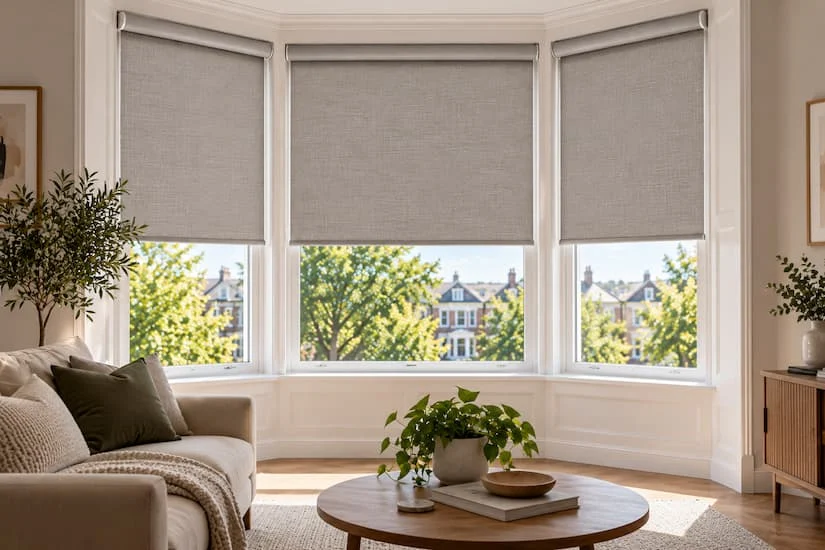
A roller blind is a straight tube. It cannot bend, and it cannot follow an angle. So a bay window, which is two or more panes meeting at corners, takes one blind per pane, each sized to its own opening.
That sounds simple. What makes it skilled work is that the panes in a bay are almost never identical, the angles are almost never exactly 45 or 90 degrees, and the whole thing is usually a little out of square because the house has moved since it was built. Period properties across Rainham, Hornchurch and Upminster are full of bays where no two panes are the same width.
This is why we do not quote bays over the phone. Anyone who gives you a bay window price without seeing it is guessing at the number of panes, the angles and the depth of the reveals. We measure every pane individually, on site, and the quote follows.
The four bay types, and what each one needs
Square or box bay
Panes meeting at right angles, the front parallel to the wall. The most straightforward, and normally three blinds. The corners are the thing to watch: at 90 degrees the two blinds meet almost edge on, so the gap between them is very visible if the sizing is out.
Splayed or angled bay
The most common in Victorian and Edwardian terraces. Side panes set at an angle, typically around 45 degrees but rarely exactly. Three blinds, and the angle has to be measured rather than assumed: a couple of degrees out over a full drop is enough to leave one blind noticeably closer to the glass than its neighbour.
Bow window
A shallow curve made up of four, five or six narrow panes. More blinds, each narrower, and the gaps multiply: five blinds means four junctions to get right. Worth taking the time over, because a bow window is the most rewarding one to get right and the most obvious when it is not.
Walk-in bay, or a bay with a door
Where the bay extends to the floor, or one pane is a door. The door pane needs its own treatment so the blind clears the handle and the door still opens. See roller blinds for French and patio doors. Floor-length blinds in a walk-in bay also need care where they meet the floor, so they do not catch as they roll.
What separates a good bay installation from a poor one
The gaps between blinds
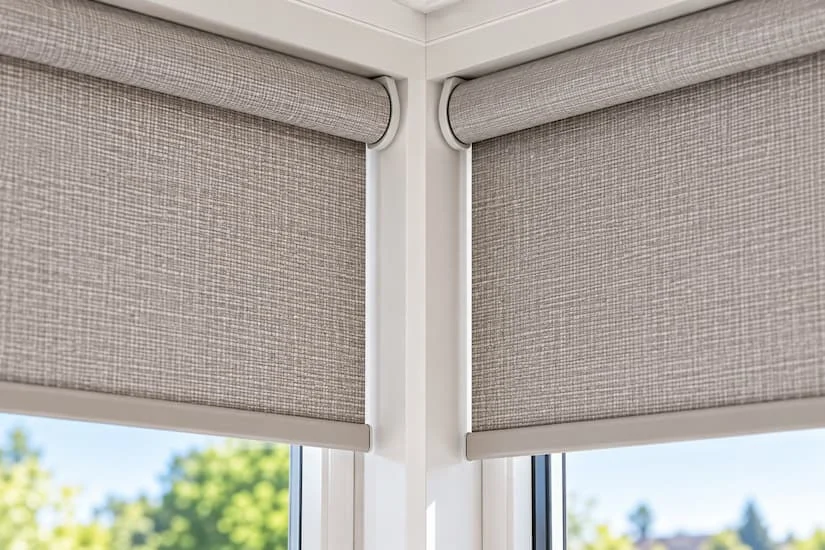
Each blind is cut slightly narrower than its opening so it can turn freely, which leaves a small gap at every junction. Those gaps should be equal and minimal. When they are not, 5mm at one corner and 20mm at the next, the eye picks it up instantly, even from across the room.
The light triangles
At each corner of a splayed bay, the two blinds meet at an angle and the gap between them forms a narrow wedge rather than a parallel slot. With a blackout fabric in a bedroom bay, those wedges are the brightest things in the room at six in the morning. If you need genuine darkness in a bay, we would fit outside the recess or add side channels, and we will raise it before you order rather than after.
Matching drops
Bay panes are often different heights, especially in older houses. Blinds cut to each opening will sit at different levels unless the drops are set deliberately to line up. It is a decision, not an accident, and it needs making at the measure.
Bracket and handle clearance
Bay reveals are frequently shallow, and window handles sit proud into the opening. A blind fitted without allowing for the handle will foul it every time the window is opened. We check every handle and stay, on every pane.
Chain sides
Three chains hanging at random points across a bay looks untidy and is awkward to use. Normally we put all the chains on the same side, or arrange them so they sit at the outer edges rather than in the middle of the run. Small decision, noticed daily.
Inside the recess or outside?
On a bay this decision changes more than it does on a flat window.
| Inside the recess | Outside the recess | |
|---|---|---|
| Look | Neat, each blind sitting within its own pane. Keeps the shape of the bay visible. | Covers the bay as one broad face. Heavier, and loses some of the bay's character. |
| Light control | Gaps at every junction, and wedge-shaped gaps at the corners of a splayed bay. | Far better: the blinds overlap the openings and the corner wedges largely disappear. |
| Practicality | Clears radiators and window seats below the sill. | May foul a radiator, a window seat or a deep sill, depending on the drop. |
| Best for | Living rooms, dining rooms, any bay where appearance leads. | Bedroom bays where darkness matters more than the outline of the bay. |
Most bays we fit are inside the recess, because that is what people want a bay to look like. The exception is a bedroom, where we will usually make the case for fitting outside, and let you decide once you have seen both options explained at your own window.
Fabric choices in a bay
Cold bays and thermal fabric
A bay is a large area of glass projecting out from the wall, with cold surfaces on three sides. It behaves like a heat sink, which is why the seating area near a bay always feels colder than the rest of the room. A thermal fabric makes a real difference here, more than it would on a single flat window.
Bedroom bays
Blackout fabric, and a serious conversation about the corner gaps. Fitting outside the recess, or adding side channels, is what turns a bay bedroom from dim to dark.
Front-facing bays on a street
The classic terrace situation: a bay a few metres from the pavement. A day and night blind gives you the view by day and privacy by evening on every pane, adjusted together.
Sunny bays
Three aspects means the bay catches sun for most of the day. A sunscreen fabric cuts glare and heat without shutting the room off from what is usually the best view in the house.
Options that suit bays particularly well
Motorised
Three to six blinds in one run is exactly the case where motorising earns its keep. One press moves all of them together, to precisely the same height, which is something that is genuinely hard to achieve by hand, and very obvious when it is not right.
Cassettes
A row of open rollers across a bay shows the mechanism repeatedly, and the eye reads it as clutter. Cassettes give a continuous clean line across the top of the run and make the separate blinds read as one treatment.
Child safety
A bay means several chains in one place, often above a window seat, which is exactly the climbable furniture that defeats the 1.5 metre rule. In a family room we would push hard for cordless or motorised here. See child-safe roller blinds.
The mistakes we get called to fix
- One blind across the whole bay. It cannot follow the angles, so it hangs across the front of the bay leaving the side panes uncovered and the shape lost.
- Panes assumed identical. Measured once and multiplied. In an older house the panes differ by enough to leave one blind visibly too narrow.
- Angles assumed to be 45 degrees. They rarely are, and the error shows as uneven gaps at the corners.
- Handles not allowed for. The blind fouls the handle, so the window cannot be opened with the blind down.
- Drops not levelled. Each blind cut to its own opening, none of them lining up across the run.
Every one of these is a measuring decision rather than a manufacturing fault, which is why we measure what we fit and fit what we measure.
What it costs
Priced per pane, not per bay
A three-pane bay is three blinds, so it costs roughly three times a single window of similar size: adjusted for the fact that bay panes are usually narrower than a standard window.
Cassettes, motors and side channels are per blind too, which is why they add up faster on a bay than anywhere else in the house. We itemise every pane so you can see exactly where the money goes and drop anything you do not want.
Related
Worth reading alongside
Blackout
Corner gaps are the whole problem in a bedroom bay. How we close them.
Read moreThermal
A bay loses more heat than any other window in the room.
Read moreMotorised
Several blinds moving to the same height, on one press.
Read moreHow to measure
Recess and exact fit explained, or let us do it free.
Read the guide


