
Home › Child-safe & cordless roller blinds
Child-safe roller blinds, and why we go further than the rules
Every blind we fit meets the UK standard, with the safety devices installed and secured as part of the job rather than left in the packet. In a room a small child uses, we will recommend removing the cord altogether, because a hazard removed beats a hazard managed.
- Devices fitted, not supplied loose
- Cordless and motorised options
- Demonstrated before we leave

The risk, stated plainly
A looped blind cord or chain hanging within a child's reach is a strangulation hazard. Toddlers are most at risk, because they are mobile, they climb, and they do not recognise a loop as dangerous. Cots, beds, sofas, chests of drawers and changing tables next to a window are the common factor in these accidents: they give a small child the height to reach a cord that would otherwise be well above them.
We are not going to put statistics on a sales page. What matters practically is that the risk is real, it is well understood, and it is almost entirely preventable by how a blind is specified and where the furniture goes.
The one thing to do today, whatever blinds you have: move cots, beds and anything climbable away from windows with corded blinds. It costs nothing, takes a minute, and removes the height a child needs to reach the cord.
What the law actually requires
Internal blinds sold and installed in the UK must meet BS EN 13120:2009+A1:2014, which is the standard used to judge whether a blind is a safe product under the General Product Safety Regulations 2005. It applies to all homes and public buildings, and to areas of commercial buildings where children between birth and 42 months are likely to be present.
In practice it means:
- Cords and chains must not present a reachable loop. Safety devices are required, and the accessible parts must sit at least 1.5 metres from the floor.
- Pull cords must not be fitted below 1.5 metres from the floor.
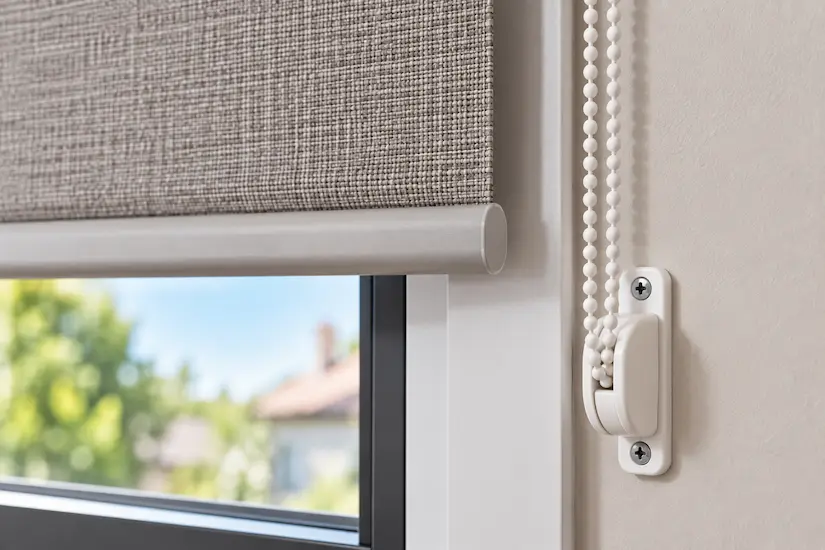
- The right device for the mechanism. Tensioning devices for looped chains, accumulation devices for pull cords, breakaway devices on certain configurations, and cord stops positioned within 50mm of the headrail.
- The installer has obligations too. Fit the blind as the standard requires, securely fix the supplementary safety devices, leave the warning labels in place, hand over the instructions, and demonstrate how the blind and its safety devices work.
Where compliance usually fails
Not in the factory. Blinds are almost always supplied compliant. It fails at the wall, in three ways we see repeatedly:
- The device is left in the bag. Supplied, never fitted. The blind is legal in the box and unsafe on the window.
- The device is fitted but not screwed to the wall. A tensioner that is not fixed does nothing: the loop is still a loop.
- Nobody explains it. The householder does not know the device must stay attached, and it gets removed during decorating and never put back.
This is why we fit the devices ourselves, fix them properly, and show you how they work before we leave. It is part of the job, not an optional extra.
Safe, safer, safest
There is a hierarchy here, and it is worth understanding before you choose.
| Option | How the risk is handled | Our view |
|---|---|---|
| Chain with a tensioner | The loop is held taut against the wall so it cannot form a noose. Compliant and safe when correctly fitted and left in place. | Fine for most rooms. Depends on the device staying fitted for the life of the blind. |
| Breakaway or safety connector | The chain separates under load rather than holding. | A useful second line of defence, not a substitute for correct fitting. |
| Spring-operated cordless | No chain at all. You push or pull the bottom bar and the blind holds position. | Our recommendation for children's rooms on smaller windows. |
| Motorised | No chain at all. Remote, wall switch, app or timer. | The best answer on larger, taller or heavier blinds, where a spring mechanism is harder work. |
The difference between the first two rows and the last two is the difference between managing a hazard and removing it. A tensioner works, provided it is fitted, fixed and never taken off. A blind with no cord cannot fail that way, because there is nothing to fail.
Cordless or motorised?
Both remove the cord. They suit different windows.
Spring-operated cordless
A tensioned spring inside the tube balances the weight of the fabric, so the blind stays where you leave it. You raise and lower it by hand on the bottom bar.
- Best for small and medium windows in bedrooms and nurseries.
- Watch out for heavier fabrics and wide blinds, where the spring has more to hold and the action gets stiff. There is also nothing to reach on a tall window: the bottom bar ends up out of reach when the blind is up.
- No power, nothing to charge, and nothing to go flat.
Motorised
A motor in the tube, controlled by remote, wall switch, app or timer. See motorised roller blinds for how the power options compare.
- Best for larger, heavier or higher blinds, and any room where several blinds should move together.
- Watch out for battery charging on a high window, and a faint motor hum if the blind runs on a timer in a bedroom.
- Costs more than spring cordless, and more than a chain.
What we would specify for a nursery
Cordless or motorised, in a blackout fabric fitted outside the recess so the blind overlaps the window and the room genuinely darkens. That combination solves the two things parents actually ask us about, safety and sleep, and it is what we fit most often in a baby's room.
A room-by-room check
Worth walking round with this in mind, whoever fitted your blinds.
- Is there a loose cord or chain anywhere a child can reach? Stand at a toddler's height and look.
- Is the safety device actually screwed to the wall? Tug it gently. If it moves freely, it is not doing its job.
- Has anything climbable moved next to a window? A cot, a bed, a toy box, a sofa arm. Furniture moves; hazards move with it.
- Are there cords in rooms where children visit rather than live? Spare rooms and grandparents' houses are where this is most often overlooked.
- Did anyone remove a device to decorate? This is the single most common way a safe blind becomes unsafe.
If you find something you are unsure about, ring us. We will tell you over the phone whether it needs attention, and we do not charge for that.
Older blinds
Blinds fitted before the 2014 amendment to the standard may never have had a safety device at all. If yours predate it, or you have inherited them with the house, they are worth checking: the requirement applies to the blind as installed today, not to the year it was bought.
Retro-fitting a tensioner to an existing chain blind is usually cheap and quick. Where the mechanism is old or the window is beside a cot, replacing it with a cordless blind is the better answer, and we will say which we think applies.
Further reading. The British Blind and Shutter Association runs the Make it Safe campaign, which has clear guidance for parents and for the trade. It is worth five minutes if you have small children and corded blinds anywhere in the house.
What it costs
Cordless costs more. We still recommend it.
A spring cordless blind sits above a chain blind, and a motorised one above that. Safety devices on a chain blind are included in what we fit: we do not charge extra for compliance.
Our usual advice with a limited budget is to put the cordless blinds in the rooms children use and leave chain blinds elsewhere. That puts the money where the risk is.
Related
Usually specified together
Blackout
The other half of a nursery specification. How to actually get the room dark.
Read moreMotorised
No cord, and the better option on larger or higher windows.
Read moreBest for bedrooms
Room-by-room advice, including nurseries and children's rooms.
Read the guideCommercial
Nurseries, schools and public buildings, where the rules apply in full.
Read more


