
Home › Day & night roller blinds
Day & night roller blinds, for rooms that need both
Two fabrics on one roller: alternating solid and sheer stripes that slide over each other. Line the stripes up and you see out. Offset them and the room closes. One chain, no second blind, and the answer to the problem sunscreen blinds have after dark.
- View and privacy on one blind
- Infinitely adjustable
- Cordless and motorised available
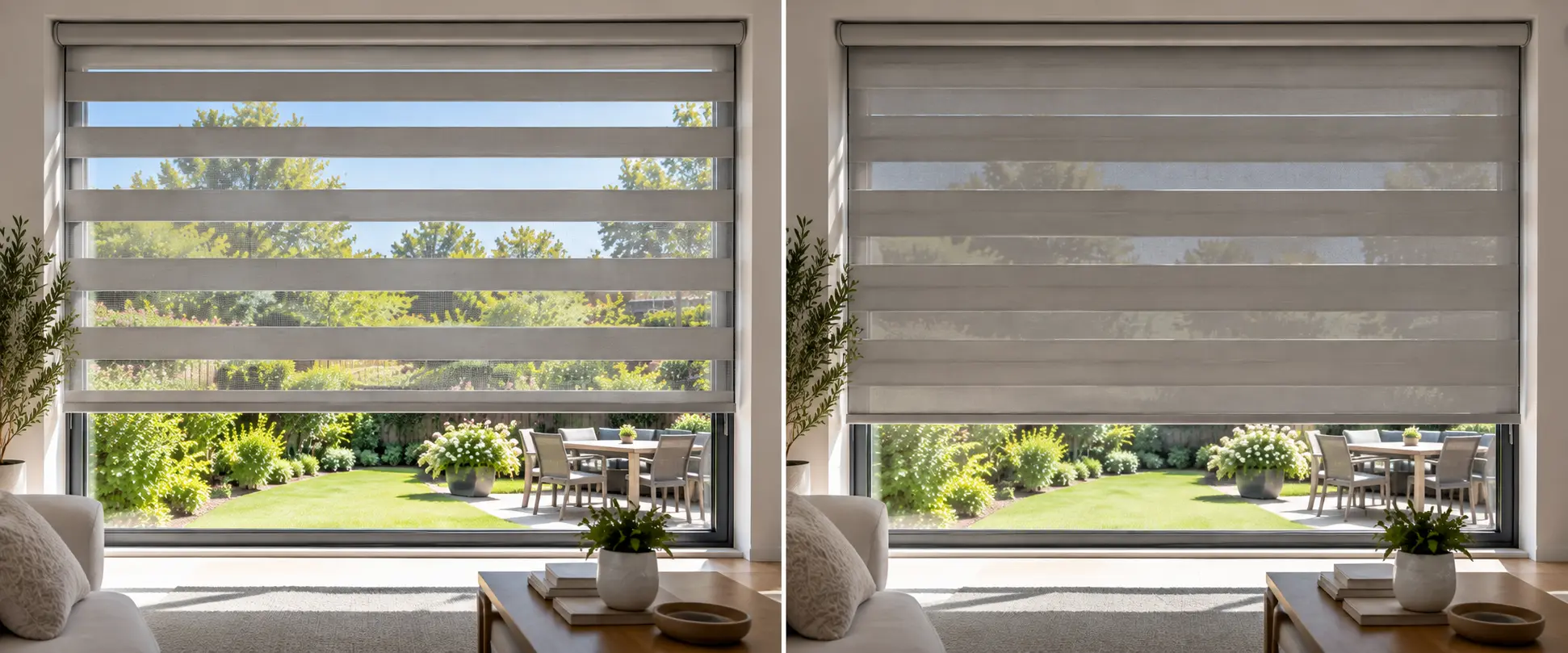
How a day & night blind works
You may have seen these sold as zebra blinds, vision blinds, double rollers, twist blinds or transitional blinds. They are the same product. We call them day & night because that is what they actually do.
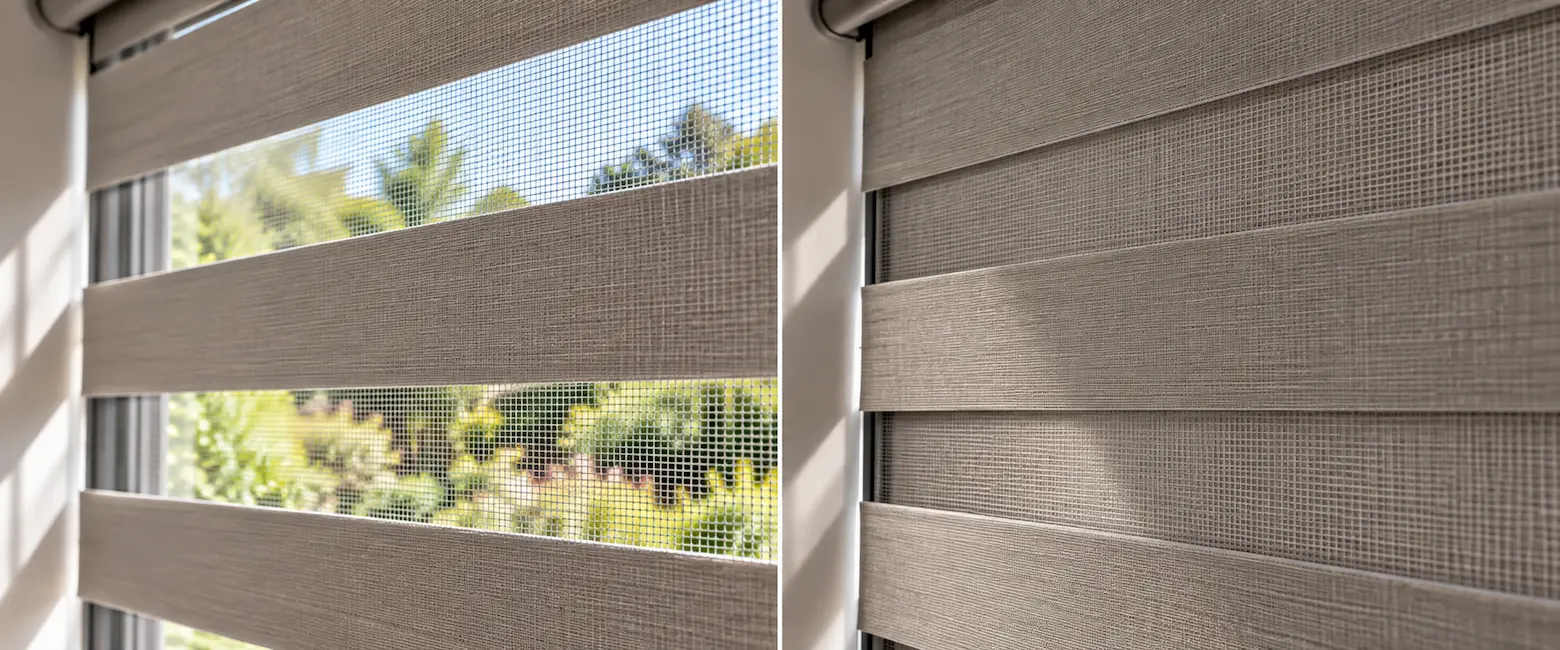
The fabric is a single length with horizontal stripes alternating between opaque and sheer, folded back on itself so two layers hang in front of the window. Pulling the chain slides one layer against the other.
- Stripes aligned: sheer sits over sheer, opaque over opaque. You get bands of clear view and daylight comes in.
- Stripes offset: opaque covers sheer. The window closes to a solid surface, and the room becomes private.
- Anywhere in between, and this is the real appeal. It is not a two-position switch; it is a slider. You can take the edge off afternoon glare without shutting the room.
Roll the whole thing up and the window is clear, exactly like a standard roller.
What it does not do: a day & night blind is not a blackout blind. Even fully closed, the opaque stripes are ordinary dim-out fabric and light comes through the seams between layers. The room goes private and dusky, not dark. For a bedroom you need to sleep in past sunrise, fit blackout instead, or as well.
Why people choose them
They solve the night privacy problem
This is the big one. A sunscreen blind is excellent by day and useless after dark, because once your lights are on you become the bright side and people outside can see in. A day & night blind gives you the daytime view and then closes properly in the evening, on the same blind, with one chain.
If you were considering sunscreen for a front-facing living room and the evening bothers you, this is usually the answer.
One blind instead of two
The alternative way to get view plus privacy is two blinds on one window, or a blind plus curtains. That costs more, takes up more of the reveal and looks heavier. A day & night blind does it in one mechanism.
Light control in steps, not jumps
With a standard roller your only control is how far down it is, which means covering part of the window to shade the rest. A day & night blind stays fully down and changes how much it lets through, so you keep the window covered evenly and still adjust the light.
The honest drawbacks
We would rather you heard these from us than discovered them after fitting.
| Drawback | What it means in practice |
|---|---|
| Not blackout | Closed, the room is private and dim, not dark. Wrong product for a nursery or a shift worker. |
| Costs more | Twice the fabric and a more complex mechanism, so expect to pay more than a plain roller of the same size. |
| More to go wrong | Two layers running against each other. Fitted badly or hung out of square, the stripes drift out of line across the width. |
| Stripes are a look | Even closed, the banding is visible up close. Most people like it. Some do not, and it is worth seeing a sample before deciding. |
| Harder to clean | Dust settles between the two layers where a cloth cannot easily reach. |
The squareness point is worth dwelling on, because it is the one that generates complaints. If the roller is not level, the two fabric layers shift relative to each other as the blind goes down, and the stripes stop matching from one side of the window to the other. On a wide window it is very visible. It is a fitting fault, not a fabric fault, which is why we fit what we measure.
Which rooms suit them
Living rooms
The most common room we fit these in, and the strongest case. You want daylight and the view while you are using the room, and privacy in the evening with the lamps on. That is precisely what this blind does.
Front-facing rooms on a street
Anywhere passers-by walk within a few metres of the window. Open during the day, closed from dusk, no need to think about it.
Dining rooms and kitchens
Where you want the garden visible while you are at the table but do not want the room exposed at night. For a kitchen, ask about how the fabric copes with cooking grease: some day & night fabrics wipe down better than others.
Home offices
Adjustable glare control without going dark, and privacy for video calls when you want it. A 5% sunscreen does the glare job better; a day & night blind does it well enough and adds the evening privacy.
Bathrooms: with a caveat
Closed, they are private enough for most bathrooms. But standard fabrics do not enjoy constant steam and two layers hold moisture between them. If the room is a busy family bathroom, a moisture-resistant roller will last longer.
Where we would steer you elsewhere
- Bedrooms where sleep matters. Not dark enough. Use blackout.
- Nurseries. Same reason, plus you want a cordless mechanism. See child-safe blinds.
- Conservatory roofs. Wrong mechanism for a sloped run. Use conservatory blinds.
- Very wide single windows. The wider the blind, the more a slight discrepancy in level shows in the stripe alignment. Above a certain width we would suggest splitting it into two blinds, and we will say so when we measure.
Options worth considering
Cassette or fascia
A day & night blind has a visibly bulkier roll at the top than a plain roller, because there is twice as much fabric on it. A cassette or a fascia panel covers that and gives a cleaner line. On these blinds specifically, it makes more visual difference than it does on a standard roller.
Motorised
Because the adjustment is a slider rather than an on-off, these blinds get touched more often than plain rollers, which makes motorising them more useful than usual. Particularly worthwhile on tall or awkward windows, or a bank of several across one room.
Child safety
The chain and safety device are the same as on any roller blind, and everything we fit meets the UK child safety regulations. In a room used by young children, cordless or motorised removes the chain entirely.
Cleaning
Roll the blind fully up and vacuum gently on low suction with a brush head, which lifts dust out from between the layers. Spot-clean marks with a barely damp cloth, working lightly: scrubbing distorts the weave and, on a striped fabric, that shows. Never soak the fabric: water between the two layers is slow to dry and can leave tide marks.
What it costs
More than a plain roller, less than two blinds
Twice the fabric and a more involved mechanism put these above a standard roller of the same size. Set against fitting two separate blinds on one window, which is the alternative way to get view plus privacy, they usually come out cheaper.
Width, drop, fabric and whether you add a cassette all move the number. We quote per window in writing after measuring.
Related
Worth comparing before you decide
Sunscreen & solar
Better daytime glare control, but no privacy once it is dark.
Read moreBlackout
If the room needs to be genuinely dark, this is the one.
Read moreBest for living rooms
Room-by-room advice on getting view, light and privacy right.
Read the guideMotorised
Especially worthwhile on a blind you adjust several times a day.
Read more


