
Home › Blackout roller blinds
Blackout roller blinds, measured so the light actually stays out
Blackout fabric blocks all the light passing through it. What lets light into the room is the gap around the edges, and that is a measuring and fitting problem, not a fabric problem. Here is how we deal with it.
- Free home measure
- Side channels available
- Child-safe fittings
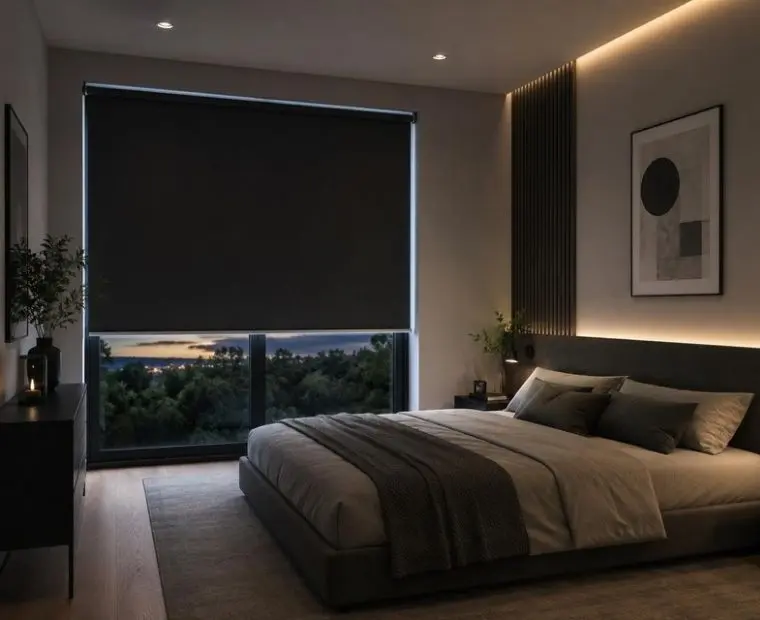
What a blackout roller blind actually is
A blackout roller blind uses a fabric that light cannot pass through. Most are woven polyester with an acrylic or PVC coating on the reverse, and some have a foam backing sprayed on in two or three layers. Hold a good blackout fabric up to a window in daylight and you will see nothing through it at all, not a glow, not a weave pattern.
That is the easy part, and every supplier in the country sells it. The difference between a blackout blind that works and one that disappoints is entirely in how it is measured and where it is fitted.
The thing most sites will not tell you: a roller blind hangs on a bracket, slightly away from the glass, and it is always cut a little narrower than the recess so it can turn without catching. So there is always a gap at each side and along the top. In a dark room at 6am in June, that gap reads as a bright outline.
Nobody is doing anything wrong when this happens. It is simply how a roller mechanism works. The question is what you do about it, and there are three answers.
Three ways to fit a blackout blind
Which one you need depends on how dark the room has to be. We will ask you this at the measure, because it changes the price and it changes how the window looks.
| Fitting | How dark | When we recommend it |
|---|---|---|
| Inside the recess | Good, with a visible outline of light at the edges | The neat, standard option. Fine for most bedrooms where you want the room dark, not pitch black. |
| Outside the recess | Much darker: the blind overlaps the opening on all sides | Nurseries, shift workers, rooms where early light is a real problem. The blind sits proud of the wall, which some people dislike. |
| With side channels | The darkest: the fabric edge runs inside an aluminium channel | Home cinema rooms, severe sleep problems, anywhere approaching true blackout. Costs more and the channels are visible. |
If you are being quoted for a nursery and nobody has mentioned outside-recess fitting or side channels, ask why. It is the single most common reason people are unhappy with a blackout blind six months later.
The light gap in numbers
Fitted inside a recess, expect roughly 10 to 15mm of clearance at each side. That sounds like nothing. In practice, on a bright morning, it is enough to light a room to the point where a sensitive sleeper wakes. Fitted outside the recess with a 75 to 100mm overlap, the same window goes genuinely dark.
Which rooms need blackout
Bedrooms
The most common request, and usually the easiest. An inside-recess blackout blind takes a bedroom from bright to comfortably dark. If you sleep through summer sunrises already, this is all you need.
Nurseries and children's rooms
Different problem. A baby who wakes at first light is a household-wide issue, so here we would normally fit outside the recess, and we would fit cordless or motorised as standard rather than as an upgrade: a chain near a cot is a hazard you do not want to manage.
Shift workers
Sleeping in daylight is the hardest case, and the one where side channels earn their cost. If you work nights, tell us at the measure and we will show you the difference honestly rather than selling you the cheaper option and hoping.
Home cinema and media rooms
Here you are controlling reflected light on a screen rather than helping someone sleep. Side channels plus a dark fabric colour, because a pale blackout fabric still bounces light back into the room even when none passes through it.
A point about colour: blackout is about what passes through the fabric, not what the fabric looks like. A white blackout blind blocks exactly as much light as a charcoal one. What changes is how much light reflects back off the blind into the room, so for a cinema room, choose dark.
Where blackout is the wrong answer
We would rather tell you this now than after fitting.
- Living rooms and kitchens. Blackout in a room you use during the day means choosing between full light and no light. A dim-out or sunscreen fabric, or a day and night blind, gives you something in between.
- Rooms where you want privacy but not darkness. That is a dim-out fabric, not blackout.
- Bathrooms. Blackout fabrics are not made for constant steam. A waterproof roller blind is the right product, and a moisture-resistant dim-out gives you the privacy.
- Conservatories. The problem there is heat and glare, not light. A solar or sunscreen fabric does far more.
Thermal benefit, and what not to expect
Blackout fabrics are denser than standard ones, and a coated blackout blind fitted close to the glass does reduce heat loss through the window. Fitted outside the recess or in side channels, where the air gap is more enclosed, the effect is larger because you are trapping a layer of still air against the glass.
That said, if saving energy is the main reason you are buying, a purpose-made thermal roller blind with a reflective backing does more. Treat the thermal performance of a blackout blind as a useful side effect, not the reason to buy one.
Child safety
Blackout blinds go into children's bedrooms more than any other type, so this matters here more than anywhere. Every blind we fit meets the UK child safety regulations, with the required safety devices installed and tensioned as part of the fitting, not left in a bag for you to sort out.
In a room with a cot or a young child, we would go further and recommend a cordless or motorised blind. No chain means no hazard, rather than a hazard that has been made safer. It costs more. We think it is worth it, and we will say so.
Cleaning and lifespan
Coated blackout fabrics do not take kindly to scrubbing: the coating is what does the blocking, and it can crack or peel if you work at it. Dust them with a soft brush or a vacuum on low suction, and spot-clean marks with a barely damp cloth and no detergent.
The other thing to know is condensation. A blackout blind pulled tight against a cold window in winter traps moisture between fabric and glass. Left every day all winter, that shows up as mould spotting along the bottom of the blind. Lift it during the day, or open the window briefly, and the problem does not arise. Our full cleaning and care guide covers this in more detail.
What it costs
Price depends on the window, not the brochure
Width and drop set the base price, the fabric moves it, and the fitting method moves it again: outside-recess fitting uses more fabric, and side channels are an additional component per window.
We quote per window in writing after measuring, and the price does not change afterwards. Our price guide sets out the ranges so you know roughly where you stand before anyone visits.
Related
If blackout is not quite right
Blackout vs sunscreen
The two fabrics do opposite jobs. This compares them side by side and says which room needs which.
Read the comparisonDay & night blinds
When you want the option of both. Two fabrics in one blind, adjusted with a single chain.
Read moreBest blinds for bedrooms
Room-by-room advice, including when a dim-out fabric beats full blackout.
Read the guideChild-safe & cordless
What the regulations require, and why we recommend going further in a child's room.
Read more


