
Buying guide
Made to Measure vs Ready Made Roller Blinds
Ready made blinds are cut to standard widths and trimmed by you at home. Made to measure blinds are manufactured to your exact opening. The gap between them is not really price: it is fit, and fit is what you look at every day.
- Free home measure across London, Essex and North Kent
- Blinds made to the nearest millimetre
- Fitted by us: no drilling, no trimming, no guesswork for you
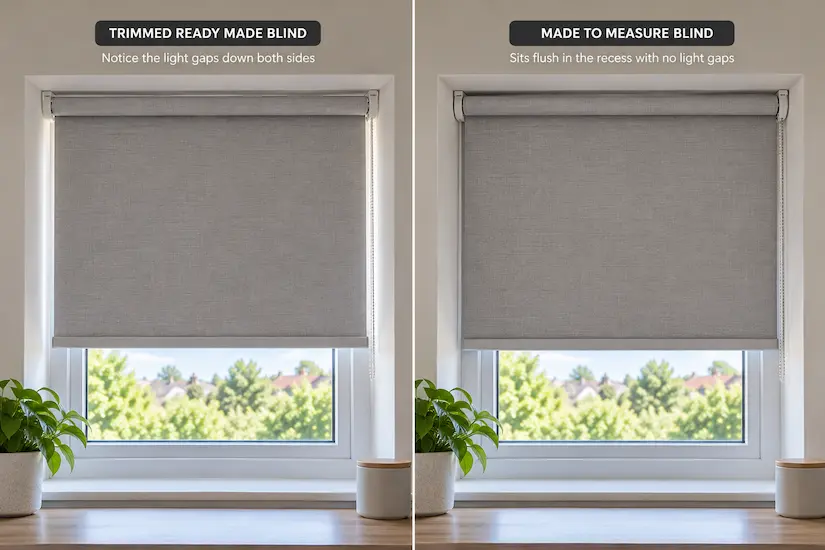
Short answer: buy ready made if the window is a standard size, the room is low-stakes (a garage, a spare room, a rental you are leaving soon) and you are confident cutting a tube and a fabric roll square. Buy made to measure everywhere else. A ready made blind that is 30 mm too narrow lets a permanent stripe of daylight down each side, and on a blackout blind in a bedroom that single detail undoes the whole purchase.
What "ready made" actually means
A ready made roller blind is manufactured in a run of fixed widths, typically 60, 90, 120, 150 and 180 cm, with a generous drop that you are expected to shorten. The fabric is pre-laminated and the bottom bar is inserted into a sewn pocket. To fit a window between two of those sizes you cut the aluminium tube, cut the bottom bar, and cut the fabric to match.
That is the part most people underestimate. Cutting the tube is easy with a hacksaw. Cutting the fabric dead square, so the blind does not track sideways as it rolls, is not. A roller blind that is out of square by two or three millimetres across its width will creep towards one end every time you raise it, and within a fortnight the fabric is rubbing the bracket.
What "made to measure" actually means
You give the manufacturer a width and a drop, and they build the blind to that size. The tube is cut on a machine, the fabric is cut on a guided blade, the brackets are set at the factory and the whole thing is tested before it is packed. Nothing on your side of the transaction involves a saw.
When we do it, a fitter measures the opening, checking the width in three places, because very few UK window recesses are actually parallel, takes the smallest of the three, applies the correct deductions for the fixing method, and orders to that. The blind arrives and goes up.
Side by side
| Ready made | Made to measure | |
|---|---|---|
| Width accuracy | Standard sizes only; you trim to fit | Exact, to the millimetre |
| Light gaps | Whatever the size difference leaves, permanently | Minimal: typically 6 to 10 mm each side inside a recess |
| Fabric choice | A few dozen lines, mostly plain | Hundreds, including blackout, sunscreen, thermal, PVC and flame-retardant |
| Awkward shapes | Not possible | Bay windows, angled tops, conservatory roofs, patio doors |
| Who does the work | You: measuring, cutting, drilling, levelling | Us, or you if you prefer to fit it yourself |
| If it goes wrong | Cut fabric cannot be returned; you buy another | Remade if the fault is ours |
| Lead time | Off the shelf, same day | Made to order after the measure |
| Typical spend | Roughly £15 to £40 a blind | From £65 for a standard roller, £95 upwards for blackout |
Our made to measure prices are set out in full on the roller blind cost guide.
The honest case for ready made
We fit made to measure blinds for a living, so take the following as a genuine concession rather than false balance: ready made blinds are a perfectly sensible buy in several situations.
The window is already a standard size
Plenty of modern new-build windows come in at close to 60 or 90 cm. If yours is within a few millimetres of a stock width, you get most of the benefit of a bespoke blind for a fraction of the money.
It is a temporary fix
A rented flat you are leaving in six months, a room mid-renovation, a window you are about to replace. Spending £250 on made to measure blinds you will not take with you is money thrown away.
Nobody sleeps or works in the room
Garages, utility rooms, downstairs loos, garden offices used for storage. Light gaps genuinely do not matter and the blind only has to provide basic privacy.
You are confident with tools
If you own a mitre box, a sharp rotary cutter and a long straight edge, and you have done this before, trimming a roller blind is a twenty-minute job.
Where ready made goes wrong
These are the four failures we are called out to most often, usually by someone who has already bought twice.
- The light stripe. A blackout blind that is narrower than the recess leaves two vertical bars of daylight on the wall. Because the eye is drawn to contrast, a 20 mm gap in an otherwise dark room reads as brighter than the same gap in a lit room. This is the single most common reason a blackout blind "does not work".
- Tracking. Fabric cut fractionally out of square walks along the tube. Every raise moves it a little further until it fouls the bracket or the roll becomes visibly conical at one end.
- A frayed edge. Ready made roller fabric is usually a laminated polyester with a coating. Cut it with scissors rather than a blade against a straight edge and the coating separates from the backing along the cut, which then peels.
- Drop not matched to sill. Because the drop is generic, the blind either stops 100 mm above the sill or piles up on it. Neither looks deliberate.
None of this is an argument that ready made blinds are badly made. They are made to a standard size and a standard size is the one thing most British windows are not: particularly in the Victorian and 1930s housing stock across Romford, Hornchurch and Ilford, where a bay can vary by 15 mm between the top and the bottom of the same opening.
What made to measure buys you that price lists do not show
Fabric you cannot get off the shelf
The ready made market is largely plain polyester in a handful of colours. Made to measure opens the full range: true blackout coatings, sunscreen fabrics with a stated openness factor for screen glare, thermal backings, moisture-resistant PVC for bathrooms, and flame-retardant fabrics certified to BS 5867-2 where a commercial setting requires them.
Shapes that do not exist ready made
A bay window needs three or five separate blinds sized individually, because the returns are almost never equal. A Velux or skylight needs side channels so the fabric does not hang away from the glass. A conservatory roof needs tensioned systems. None of these are stock items.
Child safety built in, not bolted on
All internal blinds sold or installed in the UK must meet BS EN 13120:2009+A1:2014. Ready made blinds ship with a cleat or a breakaway device in the box and rely on you fitting it correctly and at the right height. Made to measure blinds can simply be ordered cordless or motorised, which removes the hazard rather than managing it. In a child's bedroom that is the decision we would make ourselves.
Someone to hold responsible
If a made to measure blind arrives wrong and the fault is ours, it is remade. If you cut a ready made blind 10 mm short, that blind is finished and no one owes you anything.
The cost comparison people usually get wrong
On a straight per-blind basis ready made wins easily, perhaps £25 against £85. But the comparison that matters is cost over the life of the window, and there are two adjustments almost nobody makes.
Adjustment one: the second purchase
A meaningful share of ready made buyers buy twice, once to learn that the trim went wrong, once to put it right. Two £25 blinds plus a wasted afternoon is £50 and a job you now dislike.
Adjustment two: how long it stays up
A trimmed blind with a frayed edge and a tracking fault gets replaced in two or three years. A made to measure blind in a normal domestic window is still working in ten. Per year of service the gap narrows sharply.
That is not an argument that made to measure is cheaper. Over one window, once, it is not. It is an argument that the difference is smaller than the sticker price suggests, and that the difference buys fit.
If you do go ready made, do these four things
We would rather you fit a ready made blind properly than fit a bad one and conclude roller blinds are not for you.
- Measure the width in three places: top, middle and bottom of the recess, and buy for the smallest. A blind that fits at the top and jams at the bottom is the classic mistake.
- Cut the fabric with a blade against a long straight edge, not with scissors, and cut it on the roll while it is still tight. Measure the cut from the selvedge, not from the end you trimmed.
- Cut the tube and the bottom bar to the same length, and check both against the fabric before you commit.
- Fit the child safety device supplied: the cleat or breakaway connector, at the height stated in the instructions, not wherever is convenient. This is a legal requirement, not an optional extra.
Our measuring guide and fitting guide cover both jobs step by step, and they apply whether the blind came from us or from a DIY shed.
Our recommendation, room by room
Bedrooms
Made to measure, blackout, every time. Light gaps defeat the entire purpose. See roller blinds for bedrooms.
Children's rooms
Made to measure, cordless. Both for blackout and because cord-free beats a cleat.
Living rooms
Made to measure. It is the room guests see, and a trimmed blind reads as a trimmed blind. See living room blinds.
Kitchens
Either, but a wipeable made to measure fabric will outlast a ready made polyester over a hob. See kitchen blinds.
Bathrooms
Made to measure in moisture-resistant PVC. Ready made fabric in a shower room warps. See bathroom blinds.
Garages, sheds, utility
Ready made is fine. Buy the nearest size, trim it, move on.
Related guides
How to measure roller blinds
Recess and exact-fit measuring, with the deductions.
How much do roller blinds cost?
Real prices by fabric and size.
Blackout vs sunscreen
Choosing the fabric before the size.
Roller vs vertical
Which suits large glass.
Roller vs Venetian
Tilt control against clean lines.
Free fabric samples
See the fabric in your own light first.


